What Is AI Automation in Australian Warehousing and Why It Matters Now
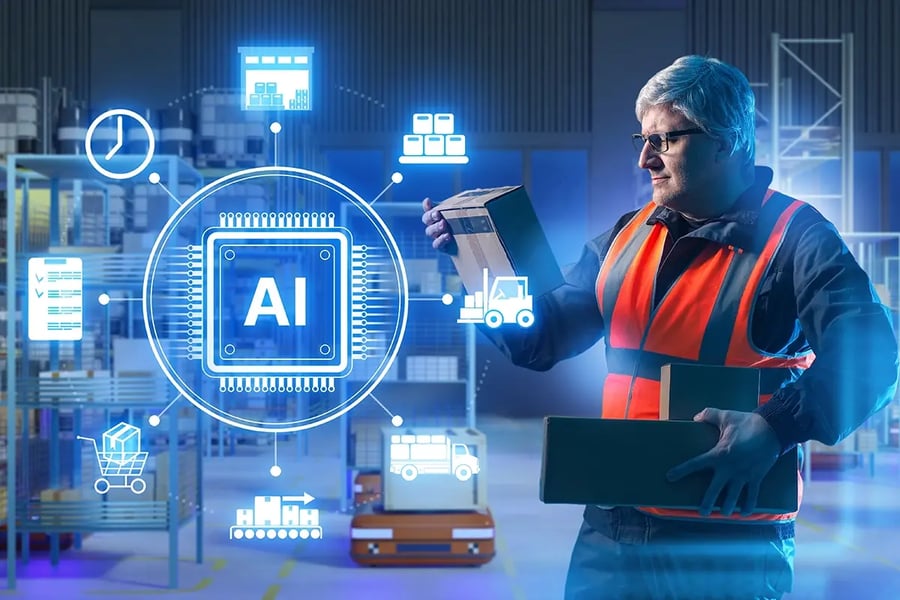
AI automation in Australian warehousing refers to the use of artificial intelligence technologies to improve forecasting, labour planning, task optimisation, exception handling and operational decision making within warehouse environments across Australia.
This matters now because warehousing businesses are operating under sustained pressure:
- Higher capital costs
- Persistent labour constraints
- Rising service expectations
- Demand volatility across sectors
AI automation in Australian warehousing addresses these pressures by strengthening decision quality across the entire warehouse lifecycle. Rather than focusing only on physical automation, it enhances the intelligence layer that governs demand, execution, exceptions and performance measurement.
For organisations investing in logistics warehouse software, the objective is not simply automation. It is operational stability, scalability and predictable margin performance.
How AI Automation in Australian Warehousing Improves Productivity and Reduces Cost to Serve
AI automation in Australian warehousing improves productivity by eliminating invisible inefficiencies that accumulate across daily operations. Most productivity loss does not come from major breakdowns. It comes from small, repeated friction points.
Common operational inefficiencies include:
- Delayed replenishment triggers that stall picking
- Misaligned putaway tasks after receipting
- Dock schedules disconnected from labour capacity
- Short picks that create rework cycles
- Inventory physically present but systemically unavailable
- Supervisors overwhelmed by preventable exceptions
AI automation in Australian warehousing resolves these issues by applying predictive analytics, real time optimisation and structured exception management.
The financial impact is measurable:
- Lower labour hours per unit
- Reduced rework and error rates
- Improved throughput stability
- Greater inventory accuracy
- Lower overall cost to serve
This is the core of warehouse productivity optimisation in the Australian market.
What Capabilities Define AI in Warehouse Management Today
AI in warehouse management delivers value in three high impact capability areas: prediction, optimisation and exception control.
Predictive Intelligence in Warehouse Operations
AI automation in Australian warehousing enables:
- Inbound peak forecasting
- Labour demand anticipation
- Replenishment prediction before pick faces fail
- Dock and staging congestion risk alerts
When integrated with a modern Warehouse management system Australia platform, predictive intelligence reduces operational volatility and strengthens service reliability.
Real Time Optimisation Across Warehouse Workflows
AI automation in Australian warehousing continuously evaluates operational constraints to make better decisions in motion. This includes:
- Dynamic task interleaving across picking, replenishment and putaway
- Wave planning adjustments based on live floor conditions
- Slotting optimisation driven by SKU velocity and physical constraints
- Route to door allocation that prevents congestion
When supported by integrated warehouse systems, these optimisation capabilities drive consistent throughput and improved asset utilisation.
Structured Exception Management and Control
A small percentage of problematic transactions typically consumes a disproportionate share of management attention. AI automation in Australian warehousing reduces this burden by:
- Detecting anomalies early
- Suggesting resolution pathways
- Routing issues with contextual information
This transforms reactive firefighting into structured performance management and supports long term warehouse productivity optimisation.
Why Warehouse Automation Australia Is Accelerating in the Current Economic Climate
Warehouse automation Australia initiatives are accelerating because operational efficiency is directly tied to margin resilience.
Operators across Australia are facing:
- Rising input and operating costs
- Labour shortages in metropolitan and regional markets
- Increasing service expectations
- Pressure for predictable performance under demand variability
AI automation in Australian warehousing is one of the few strategic levers that simultaneously:
- Lifts throughput
- Reduces cost to serve
- Minimises errors and rework
- Stabilises output during volatility
In the current economic climate, automation and AI are not discretionary investments. They are structural enablers of sustainable growth.
Why Integrated Warehouse Systems Are Critical for AI Automation in Australian Warehousing
AI automation in Australian warehousing depends on system integration. A warehouse operates on decisions, and decisions depend on connected data and workflows.
Fragmented systems create operational relay races where employees manually bridge platforms. This increases risk, delays and hidden cost.
Integrated warehouse systems ensure that:
- Demand signals feed directly into execution workflows
- Labour and equipment allocation align in real time
- Exceptions are captured and resolved within the same ecosystem
- Performance metrics are consistent across sites
Without integration, AI automation in Australian warehousing will expose inefficiencies rather than resolve them. With integration, AI becomes an orchestrator of flow.
What a Practical Roadmap for AI Automation in Australian Warehousing Looks Like
A structured roadmap ensures that AI automation in Australian warehousing delivers measurable results rather than incremental complexity.
Step One: Map High Frequency Exceptions
Identify recurring causes of delay, rework and inventory mistrust.
Step Two: Identify Manual Integration Points
Locate where employees rely on spreadsheets or informal communication to bridge systems.
Step Three: Optimise Workflow Before Automation
Stabilise processes before applying AI driven enhancements.
Step Four: Apply AI to High Impact Decision Areas
Focus on predictive labour planning, replenishment forecasting, slotting optimisation and exception management.
Step Five: Measure Executive Level Metrics
Track labour hours per unit, throughput consistency, exception resolution time, rework rates and inventory availability accuracy.
This roadmap aligns technology investment with tangible warehouse productivity optimisation outcomes.
How Logistics Warehouse Software Enables AI Automation in Australian Warehousing
Modern logistics warehouse software forms the foundation for AI automation in Australian warehousing. The platform must support:
- Real time data visibility
- End to end workflow integration
- Advanced analytics capabilities
- Scalable configuration across multiple facilities
A robust Warehouse management system Australia solution, combined with tightly integrated warehouse systems, enables AI in warehouse management to operate effectively across prediction, optimisation and exception control layers.
Technology alone does not create flow. Integration and intelligence working together do.
The Future of AI Automation in Australian Warehousing: Orchestration Over Disruption
The future of AI automation in Australian warehousing will be defined by continuous optimisation rather than one off transformation projects.
AI in warehouse management will increasingly:
- Recommend slotting adjustments based on demand shifts
- Simulate labour reallocation scenarios before execution
- Suggest next best actions to supervisors
- Capture operational knowledge and convert it into repeatable processes
This represents orchestration rather than disruption. It strengthens resilience while maintaining operational continuity.
Facilities that reduce friction, integrate workflows and apply AI intelligently will outperform those that simply add tools.
Frequently Asked Questions (FAQs)
AI automation in Australian warehousing refers to the use of artificial intelligence technologies to enhance forecasting, labour planning, task optimisation and exception management within warehouse operations across Australia. Unlike traditional automation that focuses only on machinery, AI automation in Australian warehousing improves decision making across workflows. When integrated with a Warehouse management system Australia platform and integrated warehouse systems, it enables smarter, faster and more predictable warehouse productivity optimisation.
AI automation in Australian warehousing improves cost control by reducing labour inefficiencies, minimising rework, improving inventory accuracy and stabilising throughput. By applying AI in warehouse management to predictive labour planning and replenishment forecasting, organisations can lower cost to serve while maintaining service levels. When deployed within integrated warehouse systems, AI ensures operational decisions are data driven, reducing variability and supporting sustainable warehouse productivity optimisation.
How does AI in warehouse management integrate with a Warehouse management system Australia platform?
AI in warehouse management integrates with a Warehouse management system Australia solution through embedded analytics, APIs and data connectors that enable real time data exchange. This integration allows predictive insights, optimisation algorithms and exception alerts to influence daily warehouse operations directly. Strong integrated warehouse systems ensure that AI automation in Australian warehousing functions seamlessly, enabling consistent workflow execution and measurable warehouse productivity optimisation outcomes.
Warehouse automation Australia often includes physical automation such as conveyors, robotics and mechanised storage systems. AI automation in Australian warehousing adds an intelligence layer that enhances forecasting, optimisation and exception control. AI in warehouse management focuses on improving decision quality rather than only automating physical movement. Together, physical automation and AI supported integrated warehouse systems create a comprehensive strategy for warehouse productivity optimisation.
The first measurable indicators of warehouse productivity optimisation after implementing AI automation in Australian warehousing typically include reduced labour hours per unit, lower exception volumes, improved throughput consistency and higher inventory availability accuracy. AI in warehouse management provides real time performance insights that allow organisations to track these metrics within a Warehouse management system Australia environment supported by integrated warehouse systems.
AI automation in Australian warehousing reduces labour dependency by improving task allocation accuracy, forecasting demand peaks and minimising manual rework through structured exception management. AI in warehouse management ensures labour is deployed where it creates the most value, reducing idle time and bottlenecks. When supported by integrated warehouse systems and a robust Warehouse management system Australia platform, this approach enhances stability while supporting long term warehouse productivity optimisation.
The implementation timeline for AI automation in Australian warehousing depends on system readiness and integration maturity. In environments with established integrated warehouse systems, predictive and optimisation capabilities can often be introduced in phased stages within several months. AI in warehouse management typically begins with data validation and workflow mapping before scaling across operations. A modern Warehouse management system Australia platform accelerates deployment and supports structured warehouse productivity optimisation.
AI automation in Australian warehousing improves inventory accuracy by detecting anomalies early, predicting replenishment requirements and reducing manual intervention points that introduce errors. AI in warehouse management analyses transaction patterns to identify discrepancies and prevent stock imbalances. When deployed across integrated warehouse systems within a unified Warehouse management system Australia solution, organisations gain consistent real time visibility and enhanced warehouse productivity optimisation across multiple sites.
AI automation in Australian warehousing supports logistics operations across the ANZ region by standardising workflows, improving cross site forecasting and enhancing exception control across both Australian and New Zealand facilities. AI in warehouse management ensures consistent performance metrics and operational visibility when powered by integrated warehouse systems. A unified Warehouse management system Australia platform enables coordinated warehouse productivity optimisation across the broader ANZ region, supporting scalable and resilient distribution networks.

Daniel Adamek is Vice President and Head of Logistics – Oceania at Ramco Systems, with over 20 years of experience in transport, logistics, and supply chain transformation. He has worked closely with large 3PLs and enterprise operators, specialising in TMS, WMS, fleet management, payroll, compliance, and ERP integrations. Daniel is known for helping logistics organisations reduce cost-to-serve through integrated platforms, automation, and practical change management. Outside of work, he enjoys industry networking, mentoring emerging leaders, and spending time with family.