












Transportation Management System Australia: TMS Software Guide
A Transportation Management System (TMS) is a logistics technology platform that helps ANZ businesses automate transportation planning, optimise routes, reduce freight costs, improve shipment visibility, and enhance supply chain performance through real-time data and intelligent automation.
Key Takeaways:
- A Transportation Management System (TMS) provides end-to-end control over logistics operations by helping businesses plan shipments, optimise routes, manage carriers, and gain real-time visibility across their transportation networks.
- Modern TMS platforms help reduce freight costs and improve operational efficiency through intelligent automation, AI-driven planning, accurate carrier selection, and data-backed decision-making that eliminates manual processes.
- A TMS enables industry-specific logistics performance across 3PL, cold chain, and e-commerce operations by supporting profitability tracking, compliance monitoring, last-mile optimisation, and scalable delivery management.
- Integrating TMS with ERP, WMS, FMS, and billing systems creates a connected supply chain ecosystem that improves data accuracy, accelerates workflows, and helps ANZ businesses build more resilient and agile logistics operations.
Introduction
Is Your Supply Chain Ready? The Complete Guide to Transportation Management Systems (TMS)
Logistics teams across Australia and New Zealand are working under immense pressure as delivery expectations keep climbing higher every year. The ‘Amazon effect’ has changed everything, as customers now demand speed and consistency for every single delivery they receive. Not to mention, the rising fuel costs and tight deadlines have turned daily supply chain operations into a non-stop race against the clock.
The Australian freight and logistics industry is estimated to grow from US$99 billion in 2025 to US$122.7 billion in 2030. If you are not actively optimising your operations right now, you are already losing ground to competitors who are adapting. The increasing fuel prices and tight delivery commitments are transforming supply chain operations into a continuous performance race.
Many ANZ fleet managers still rely on chaotic spreadsheets, endless phone calls, missed emails, and whiteboard planning, which ends up creating a ‘black hole’ of visibility. You do not know where your trucks are or when they will arrive at the customer's dock.
The answer to this chaos is a Transportation Management System (TMS). It serves as the ‘central nervous system’ for your entire logistics operation by connecting every moving part of your supply chain, giving you control and clarity.
What is a TMS, and How Do Modern Logistics Teams Use It?
A Transportation Management System (TMS) is a digital platform that assists businesses in planning, executing, monitoring, and optimising the physical movement of goods. It acts as the critical bridge between an order being placed and a satisfied customer signing for the delivery.
Legacy logistics software ran on rigid on-premise infrastructure that limited agility. In contrast, modern TMS systems are cloud-based, AI-driven, scalable, and fully accessible on mobile devices for remote management. This evolution enables dispatchers to manage fleets from anywhere while maintaining agility in a fast-paced market. Here is how modern logistics teams are using TMS to streamline their operations:
- The Planning: Modern teams use these tools to select the most efficient carrier and route. The system analyses real-time cost data and delivery windows to make the best decision. This ensures you satisfy customer requirements without overspending on unnecessary freight charges.
- The Execution: Automation handles the manual work of booking shipments and printing labels. The platform assigns drivers automatically without human intervention. This reduces administrative overhead and eliminates the risk of typing errors that often lead to failed deliveries or lost packages.
- The Visibility: Providing real-time tracking is now a standard expectation for B2B shipments. Transportation management solutions offer ‘Uber-like’ visibility. Customers are able to see exactly where their goods are, reducing the volume of ‘where is my order’ calls your support team receives.
The global logistics market is steadily shifting toward AI adoption. As of 2024, over 50% of supply chain organisations are investing in advanced analytics. These tools predict disruptions before they occur, allowing businesses to pivot strategies proactively rather than reacting to problems after they cause delays.
What Are the Critical TMS Capabilities for 3PLs, Cold Chain, and E-commerce?
Different sectors have unique needs that generic software cannot meet. Here is how a robust Transportation Management System adapts to specific industry demands, ensuring compliance and efficiency across the board.
3PLs
Logistics providers must know the exact margin on every single shipment to remain profitable. A modern TMS automates the ‘buy low, sell high’ logic of freight rates. This capability ensures you capture every dollar of revenue while maintaining transparent relationships with your clients. Here is how a TMS helps third-party logistics providers:
- Automates complex client billing cycles accurately to ensure invoices are sent out immediately after delivery completion.
- Tracks profitability per shipment in real-time so you can identify loss-making accounts or routes instantly.
- Manages multi-client inventory seamlessly, allowing you to service various customers from a single distribution hub efficiently.
- Reduces revenue leakage from unbilled services which often occurs when relying on manual paperwork and spreadsheets.
This level of financial clarity allows 3PL providers to scale their operations without increasing administrative headcount.
Cold Chain
Delivering on time is insufficient; you must prove the temperature never fluctuated during transit. With ANZ’s strict compliance standards, real-time temperature monitoring is non-negotiable. These features of a modern TMS protect high-value perishable goods and ensure your business meets rigorous food and safety regulations.
Let’s have a look at the advanced monitoring features of a TMS that ensure total visibility across the journey:
- Integrates with IoT sensors for live tracking to provide constant visibility into the condition of your refrigerated cargo.
- Triggers alerts if temperature deviates instantly so drivers can take corrective action before the cargo is spoiled.
- Generates automatic compliance reports for audits, saving your team hours of manual data gathering during inspections.
- Maintains a digital audit trail for safety to protect your business against liability claims regarding product quality.
Automated monitoring protects your reputation and reduces insurance claims related to spoiled inventory.
E-commerce
With Australian online sales crossing AUD 69 billion in 2024, the pressure is on for ‘same-day’ delivery. A TMS can easily handle the high volume of small parcels that would crash a manual process. It ensures efficient transfers between long-haul trucks and local delivery vans.
Following are the key aspects of a TMS to streamline the chaotic last-mile delivery process.
- Optimises multi-stop local delivery routes to ensure drivers can complete more drops per hour in urban areas.
- Automates carrier selection for small parcels to find the lowest cost option that meets the delivery promise.
- Provides branded tracking pages for shoppers so they stay engaged with your brand while waiting for packages.
- Handles seamless returns management processes which is critical for maintaining customer loyalty in the competitive retail sector.
‘Hub and Spoke’ optimisation is a critical feature for covering the vast geographical distances in Australia and New Zealand. It ensures efficient transfers between long-haul trucks and local delivery vans to maximise reach and minimise costs.
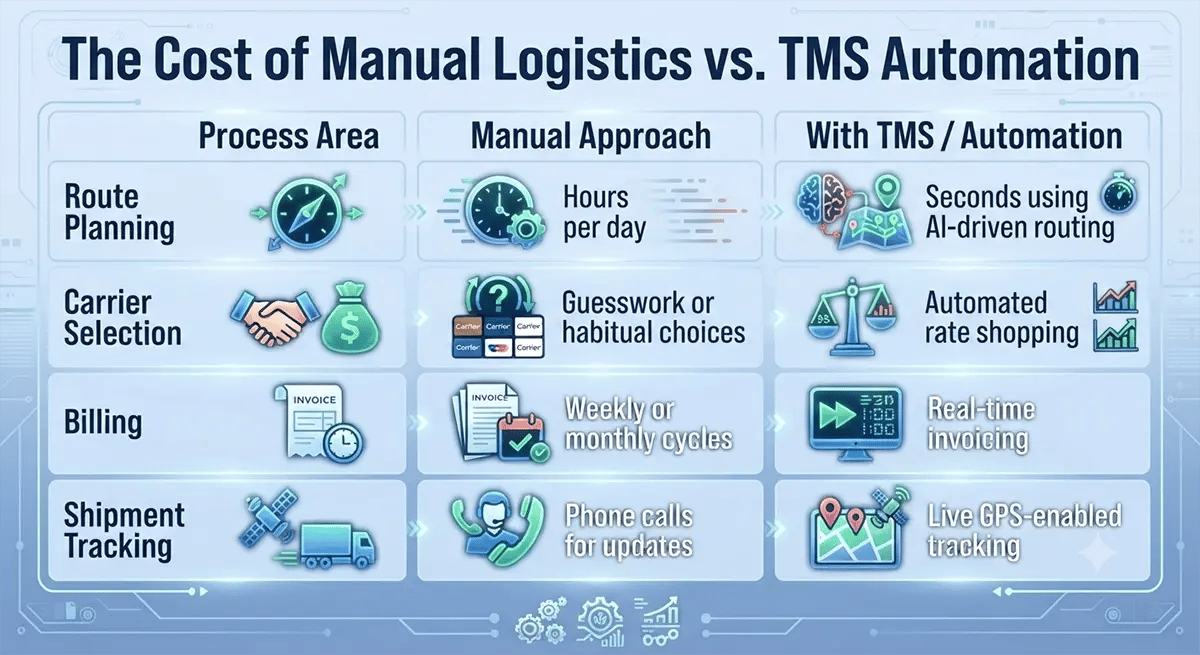
How Does a TMS Reduce Operational Costs and Improve Delivery Accuracy?
Implementing a transportation management system directly impacts your bottom line by removing inefficiencies that drain your operational budget. It replaces human guesswork with data-driven decisions that improve service and boost overall fleet efficiency.
- Route Optimisation: Algorithms beat human planning every time because they can process thousands of variables simultaneously to find the best path. The software considers traffic patterns, weather conditions, road restrictions, and vehicle capacity to significantly reduce empty miles. Route optimisation ensures you maximise fleet utilisation and avoid sending half-empty trucks across the country, which wastes fuel.
- Carrier Selection: Automating the ‘Rate Shopping’ process ensures you always pick the cheapest carrier that meets the service level agreement (SLA). This prevents ‘maverick spend’ where staff might otherwise book their favourite, more expensive carrier regardless of the cost.
- Delivery Accuracy: In 2024, the average On-Time Delivery (OTD) rate hovered around 85-90%. This leaves significant room for operational improvement, as top performers report OTD above 95%. A well-implemented TMS helps reduce manual data errors such as incorrect addresses or weights, enabling companies to move closer to best-in-class delivery performance.
- Inventory Alignment: Warehouse teams receive accurate pickup timings, allowing them to avoid last-minute rushes. This alignment reduces congestion at docks, improves labour utilisation, and maintains dependable dispatch activity throughout the day.
How Do You Integrate a TMS with WMS, FMS, ERP, and Billing Systems?
A transportation management system cannot operate in isolation to achieve true end-to-end supply chain visibility. To function effectively, it needs to talk to your Warehouse Management System (WMS) and your Finance team’s ERP.
When these systems remain disconnected, valuable data gets trapped in silos that create barriers between your operational teams. This isolation results in delayed shipments and billing errors because information is not shared instantly across different departments.
You can bridge this gap by implementing an integrated workflow that automatically moves data through every operational stage.
- ERP to TMS: Sales orders flow automatically into the transport platform to create shipments without any manual data entry required.
- WMS to TMS: The WMS software tells the transport software exactly when the pallet is packed and ready for pickup.
- TMS to Billing: Once delivered, the system sends ‘Proof of Delivery’ (POD) to finance to trigger the invoice immediately.
This seamless flow significantly reduces the ‘Order-to-Cash’ cycle because you are not waiting weeks for paperwork to return. Automation speeds cash flow and reduces your accounting team's workload by eliminating manual reconciliation tasks.
90% of supply chain leaders feel they lack the talent to handle complex digitization, hindering technology adoption. Therefore, modern platforms often include ‘plug-and-play’ connectors to standard ERPs, significantly simplifying the integration process. This lowers the technical barrier for implementation and reduces the need for expensive custom coding or IT support.
What Are Common TMS Challenges and How Do Modern Platforms Solve Them?
Adopting new technology comes with hurdles, as employees may resist changing their established workflows and daily habits. However, modern solutions are designed to overcome these common obstacles and ensure high user adoption across your organisation.
- Change Management: Drivers and dispatchers often love their whiteboards and resist new tools because they fear technology will complicate their jobs. Modern platforms solve this issue by offering visual planning tools with drag-and-drop interfaces that look like the apps they use daily. This familiarity makes training easy and intuitive for non-technical staff, which significantly accelerates the onboarding process for everyone involved.
- Yard Congestion: Trucks waiting at the dock cost money and disrupt schedules, creating a ripple effect of delays throughout the entire day. A recent report found 38% of companies report congestion as their biggest yard issue affecting overall warehouse efficiency and throughput. Time Slot Management features solve this by letting carriers book their own dock appointments to smooth out activity peaks.
- Complexity: Many operators believe that a TMS is too expensive or complex for a mid-sized fleet to implement successfully. Cloud-based SaaS models have democratized access, allowing you to pay per transaction or user rather than investing heavily upfront. This makes it accessible for growing businesses that need enterprise-level tools without the crushing weight of an enterprise-level price tag.
- Data Accuracy: Incorrect data creates issues across reporting, billing and customer communication. Modern TMS platforms enforce strict validation to prevent errors from entering live workflows. This discipline improves operational consistency and financial accuracy.
This is where platforms like Ramco Logistics Software solve the complexity puzzle by offering a comprehensive, all-in-one platform. Unlike disjointed systems, Ramco offers a unified Logistics Management Software that brings TMS, ERP, and WMS solutions under one roof. This ‘Control Tower’ approach gives you a single source of truth for every shipment, helping you manage exceptions.
Ramco takes it a step further with features like Heijunka Planning (load levelling) and advanced Visual Planning tools. These capabilities help teams manage exceptions quickly while maintaining stability across growing networks. Ramco has extensive experience supporting ANZ transport operations, enabling companies to address regional compliance requirements, geographic constraints, and sector-specific workflows effectively.
Schedule a demo and discover how Ramco TMS can optimize your operations today.

About Ramco Logistics Platform
Ramco Logistics Platform provides a cloud-based integrated solution tailor-made for third party logistics and express parcel service providers. The software helps to overcome key pain points, including supply shortages, limited resources, operational costs, the surge in demand and new compliance rules. The integrated solution encompasses transportation management system, warehouse management system, fleet & hub management and rating & billing. Trusted by over 25+ logistics companies worldwide, the platform is powered by NextGen AI & ML features that help logistics service providers reduce cost and acquire new customers.
 What is a Transportation Management System (TMS)?