
















Warehouse Management System (WMS) Guide for ANZ Warehouses
A Warehouse Management System (WMS) is a digital platform that helps businesses optimise inventory accuracy, warehouse productivity, fulfilment speed, and operational control. Modern WMS solutions automate key warehouse processes including receiving, putaway, picking, packing, shipping, and labour management while providing real-time visibility. By integrating with ERP, TMS, automation, IoT, and RFID technologies, WMS enables smarter, scalable warehouse operations. For Australian and New Zealand businesses, a WMS helps overcome rising warehouse costs, labour challenges, and increasing e-commerce fulfilment demands.
Key Takeaways
- A WMS improves warehouse accuracy and control by providing real-time inventory visibility, eliminating stock discrepancies, reducing ghost inventory, and ensuring every movement is tracked from receiving to dispatch.
- A WMS increases productivity and reduces operational costs through intelligent putaway, optimised picking routes, labour management, task automation, and improved space utilisation.
- A modern WMS connects the entire supply chain ecosystem by integrating with ERP, TMS, robotics, RFID, IoT, and automation systems to create seamless data flow and better decision-making.
- A WMS enables scalable fulfillment for modern businesses by helping 3PLs, retailers, manufacturers, and e-commerce companies manage higher volumes, faster delivery expectations, and complex warehouse operations efficiently.
Is Your Warehouse Ready? The Complete Guide to Warehouse Management Systems (WMS)
Supply chain leaders across Australia and New Zealand currently face a critical dilemma regarding space and speed. Industrial real estate costs in major hubs like Sydney and Auckland continue to rise, yet customers increasingly demand same-day delivery service. This pressure forces businesses to maximise every square metre of storage while simultaneously accelerating the throughput.
The warehouse has transitioned from a passive storage shed into a dynamic fulfilment engine. Modern operations require a digital backbone that coordinates inventory, labour, and automation with precision. Relying on spreadsheets or legacy systems often leads to inefficiencies as order volumes grow.
The global warehousing automation market is projected to grow significantly from US$29.9 billion in 2025 to US$63.3 billion in 2030 with a CAGR of 16.2%. This surge indicates that competitors are already investing heavily in technology to reduce manual dependency. If your operation remains manual, you risk falling behind in both efficiency and customer service standards.
The solution lies in implementing an advanced Warehouse Management System (WMS) that acts as the digital brain of your supply chain. By replacing manual guesswork with algorithmic certainty, a WMS allows you to scale operations efficiently. This technology helps businesses handle increased complexity without exponentially increasing their headcount or physical footprint.
What is a WMS and Why Does It Matter for Inventory Accuracy?
A Warehouse Management System (WMS) is the software that controls all operations within a warehouse. It tracks where stock is located, directs who moves it and determines when it leaves. This system is crucial as it replaces estimation with real-time certainty and ensures that what the system shows matches what is physically on the shelf.
Here is why this precision is essential for your business.
- The Ghost Inventory Problem: One of the costliest issues in logistics is ghost inventory. This occurs when your system says an item is in stock while the shelf remains empty. This leads to unfulfilled orders and frustrated customers. Manual warehouse stock management systems and processes often fail to detect these errors until it is too late.
- The Accuracy Impact: Implementing warehouse management software significantly reduces shrinkage and errors by enforcing scanning validation at every touchpoint. Modern solutions like Ramco WMS can achieve 99.9% inventory accuracy. This high level of precision eliminates the need for expensive annual shutdowns required for physical stocktakes.
- Regional Relevance: Accuracy is particularly critical for ANZ importers who deal with long lead times from Asian manufacturing hubs. When replenishment takes weeks to arrive by sea, you must ensure every item is tracked correctly. You simply cannot afford to lose stock or misplace critical items due to poor tracking within your own facility.
- Financial Visibility: Along with operational benefits, a WMS provides the finance team with an accurate view of working capital. By reducing stock discrepancies, businesses can lower their safety stock levels. This efficiency frees up significant cash flow that would else be tied up in excess inventory buffers.
What Core Features in a WMS Optimise Putaway, Picking, Packing and Cycle Counting?
To understand how WMS software optimises operations, you must consider the core functions that govern the flow of goods. These features work together to create a continuous and optimised loop of movement. This integration minimises manual touchpoints and maximises storage density within your facility.
- Intelligent Putaway: This goes beyond placing items on a vacant shelf. It focuses on optimising space utilisation. The WMS directs forklifts to the best slot based on size, weight, and velocity. This ensures fast-moving items are stored near the dock to reduce travel time during retrieval.
- Picking Strategies: A robust warehouse management system software enables various advanced methods to suit your specific volume.
- Zone Picking keeps pickers in assigned areas to reduce congestion.
- Wave Picking groups orders in batches for efficiency.
- Cluster Picking allows workers to pick multiple orders into different containers simultaneously.
- Packing and Dispatch: The system ensures the right item goes into the right box with the correct shipping label. This validation significantly reduces returns. By checking items against the order details before sealing, warehouse software systems prevent costly shipping errors that damage brand reputation.
- Cycle Counting: This feature facilitates the shift from disruptive annual stocktakes to a perpetual inventory model. It directs staff to count specific locations during downtime. This keeps inventory records accurate daily without ever needing to pause operations for a full count.
How Does a WMS Improve Fulfillment Speed and Warehouse Productivity?
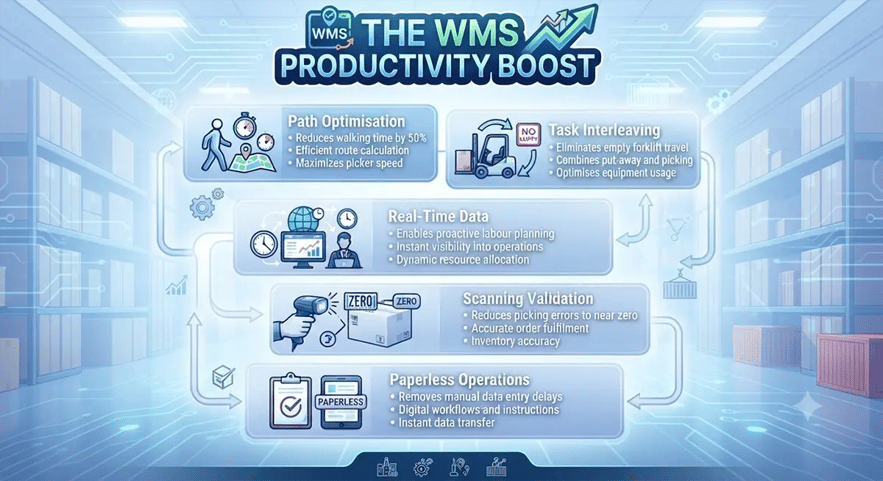
A warehouse management system improves speed by calculating the most efficient travel paths for pickers. This calculation can reduce walking time by up to 50%. It boosts productivity through task interleaving where workers perform multiple tasks in a single trip. The following features explain how the software achieves these gains.
- Eliminating Walking Time: Travel time typically accounts for 50 to 60% of a picker’s day in a manual warehouse. Advanced WMS software calculates the most efficient snake path through the aisles. This guidance ensures workers pick more items with fewer steps, which directly accelerates order processing speed.
- Task Interleaving: The system combines tasks to maximise equipment utilisation and reduce wasted movement. A forklift driver drops off a pallet at the receiving dock and is immediately directed to pick up a return or move stock on their way back. This ensures the vehicle never travels empty.
- Workforce Management: Using data to measure individual performance allows managers to plan labour shifts based on predicted volume. Warehouse management software provides visibility into who is performing well and where bottlenecks are occurring. This insight enables proactive coaching and resource allocation.
Warehouses implementing advanced WMS systems can see up to 40% increase in labour productivity within the first few months. This efficiency gain allows businesses to handle higher order volumes during peak seasons without necessarily hiring additional temporary staff.
How Do You Integrate a WMS with ERP, TMS, and Automation Systems?
A modern WMS works best when it integrates seamlessly with your broader technology stack, enabling real-time data exchange. This connectivity ensures that all teams can view a single source of truth regarding inventory and order status.
Here is how the ecosystem connects:
- The Connected Ecosystem: A warehouse inventory management software acts as the central hub while relying on data from other systems. It needs to receive sales orders and purchase orders instantly to trigger workflows. This ensures that the warehouse is always synchronised with customer demand.
- ERP Integration: This is the link where orders flow down from the ERP and inventory updates flow up. When the WMS software confirms receipt or shipment, the ERP financial records are automatically updated. This ensures accurate billing and stock valuation without manual data entry.
- TMS Integration: This represents the critical handover between the warehouse and the carrier. As the WMS guides the packing process, it communicates with the TMS to generate the correct shipping label immediately. This streamlines the dispatch process and reduces dock congestion.
- Automation and MHE: Integration connects the software with physical hardware like conveyors, sortation systems, and Automated Storage and Retrieval Systems (AS/RS). The WMS acts as the conductor. It sends instructions to these machines to move goods efficiently without human intervention.
- Key Insight: Many large enterprises are prioritising composable supply chain tech stacks in 2025 to ensure these systems talk to each other fluently. This trend highlights the need for WMS software companies to offer open APIs and flexible integration capabilities.

What is the Role of IoT, RFID, and Real-time Visibility in a Modern WMS?
IoT and RFID technologies are changing the best warehouse management system solutions from passive recording tools into active sensing networks enabling granular visibility. They allow managers to track assets instantly and monitor environmental conditions without manual scanning or intervention.
- Beyond Barcodes: The industry is moving from manual barcode scanning to sensing inventory presence automatically. This shift reduces the labour required for tracking. It ensures that the digital inventory record always matches the physical reality in real time.
- Radio Frequency Identification (RFID): This technology is ideal for high-value or high-volume counting without line-of-sight requirements. A warehouse inventory tracking system equipped with RFID can scan an entire pallet of goods in seconds as it passes through a dock door portal.
- IoT Sensors: Monitoring temperature is crucial for the ANZ Cold Chain sector to ensure compliance and quality. Sensors integrated with warehouse software systems can alert managers immediately if a freezer zone deviates from the set temperature. This helps prevent costly stock spoilage.
- Real-Time Visibility: These tools give customer service teams the ability to see exactly where an order is located. Whether it is in the packing lane or on the truck, they can inform the customer instantly. This transparency reduces the need for internal emails and calls to the warehouse floor.
- Future Trend: Vision Picking using AR glasses is gaining traction in Australian distribution centres. This hands-free technology overlays picking instructions directly into the worker's field of view. It further improves speed and accuracy in complex warehouse systems.
Why Ramco Logistics Software is the Choice for High-Volume Operations?
Managing a high-volume warehouse with disjointed systems results in inefficiency and lost revenue. As order volumes grow, the cracks in manual processes widen which leads to missed shipments and ballooning costs. Ramco Logistics Software offers a powerful solution designed to unify and optimise these complex operations for the future.
- The Unified Advantage: Ramco offers more than a standalone WMS. We provide a unified Logistics ERP. Our platform brings Warehouse Management Software (WMS), Transportation Management (TMS), Finance, and HR under one roof. This unification eliminates data silos and ensures seamless information flow across your business.
- AI and ML Power: Ramco leverages Artificial Intelligence for advanced capabilities like Slotting Optimization. This feature automatically suggests where to store items based on their churn rate. Our Command Center provides end-to-end visibility, enabling you to manage exceptions before they impact customers proactively.
- 3PL Specialization: Ramco is specifically built to handle the rigorous demands of the ANZ 3PL market. We simplify complex, multi-client billing and operations. This capability allows logistics providers to onboard new clients quickly and manage diverse inventory requirements within a single warehouse management system.
Stop managing your warehouse on spreadsheets and start optimising for the future. Contact us today and discover how Ramco Logistics Software can transform your fulfillment.

About Ramco Logistics Platform
Ramco Logistics Platform provides a cloud-based integrated solution tailor-made for third party logistics and express parcel service providers. The software helps to overcome key pain points, including supply shortages, limited resources, operational costs, the surge in demand and new compliance rules. The integrated solution encompasses transportation management system, warehouse management system, fleet & hub management and rating & billing. Trusted by over 25+ logistics companies worldwide, the platform is powered by NextGen AI & ML features that help logistics service providers reduce cost and acquire new customers.
Frequently Asked Questions (FAQs)
 What is a Warehouse Management System (WMS)?
How does a Warehouse Management System work?
Why is a WMS important for modern warehouses?
What problems does a WMS solve?
What are the key features of a modern WMS?
A modern Warehouse Management System includes features such as:
- Real-time inventory tracking
- Intelligent putaway optimisation
- Picking and packing optimisation
- Barcode and RFID integration
- Cycle counting
- Labour management
- Slotting optimisation
- Order fulfilment management
- Warehouse analytics and reporting
- ERP, TMS, and automation integration
These capabilities help warehouses improve accuracy, speed, and operational control.
How does a WMS improve inventory accuracy?
How does a WMS reduce warehouse costs?
What KPIs improve with a WMS?
A WMS helps improve key warehouse performance indicators, including:
- Order Cycle Time
- Inventory Accuracy
- Order Picking Accuracy
- Inventory Turnover
- Dock-to-Stock Time
- Labour Productivity
- Warehouse Throughput
- Order Fulfilment Rate
These metrics help businesses identify bottlenecks and continuously improve warehouse operations.
What is the difference between WMS and Inventory Management?
How does a WMS integrate with ERP, TMS, and automation systems?
A WMS integrates with ERP systems to synchronise orders, inventory, and financial data. It connects with Transportation Management Systems (TMS) to streamline shipping and carrier processes, while integrations with automation technologies enable coordination with conveyors, robotics, and Automated Storage and Retrieval Systems (AS/RS).
This creates a connected warehouse ecosystem with real-time data flow across the supply chain.
How does automation integrate with WMS?
What features should a 3PL look for in a WMS?
Third-party logistics providers should look for WMS capabilities such as multi-client architecture, automated billing for storage and handling, customer portals, configurable workflows, inventory visibility, and reporting tools.
These features help 3PLs manage multiple customers within the same facility while improving operational efficiency, transparency, and profitability.
Is WMS required for omnichannel or e-commerce fulfilment?
Yes. A WMS is critical for omnichannel and e-commerce fulfilment because manual processes struggle with high order volumes, single-item picking, fast delivery expectations, and complex returns management.
A cloud-based WMS helps businesses improve fulfilment speed, maintain accurate inventory availability, manage peak demand, and deliver better customer experiences.
Why do Australian and New Zealand businesses need a WMS?
Australian and New Zealand businesses need WMS solutions to overcome challenges such as rising warehouse costs, increasing e-commerce demand, labour shortages, and complex distribution networks.
A WMS helps ANZ organisations maximise warehouse space, improve inventory accuracy, increase fulfilment speed, and build scalable supply chain operations.