What is Agentic AI for Aviation Maintenance?

How Agentic AI for Aviation Maintenance Transforms SB & AD Processing
How Agentic AI for Aviation Maintenance Transforms SB & AD Processing
9:57
Published :
Key Takeaways:
Aviation runs on documentation. Every aircraft in service is backed by a paper trail of manuals, bulletins, and directives that tell engineering teams what needs attention and when. Among all of these, Service Bulletins (SB) and Airworthiness Directives (AD) carry the most weight. One is a manufacturer's recommendation. The other is a regulator's mandate. Neither gets ignored.
When a new SB or AD is released, engineering teams have to move fast. They need to know which aircraft in the fleet are actually affected, what the required procedures involve, which parts and tooling are needed, and how much time they have before the compliance window closes. None of this is optional, and none of it happens on its own.
For most organizations, that work still starts with someone opening a lengthy OEM document and reading through it line by line. Effectivity conditions, part numbers, labour estimates, and timelines all sit buried inside dense technical formatting that was built for engineers who designed the aircraft, not necessarily for the teams maintaining it years later. Getting from a raw document to an actionable maintenance plan takes real time, and time is exactly what compliance deadlines don't leave much room for.
This is the problem agentic AI is starting to solve in aviation maintenance, and it's reshaping how quickly engineering teams can turn a new bulletin into a completed, documented action.
Safety is the foundation of everything in air travel, and the aviation maintenance ecosystem exists for one purpose: keeping every aircraft airworthy. Service Bulletins and Airworthiness Directives sit at the core of that framework.
SBs come from the manufacturer. They are recommendations to improve or modify the aircraft based on what the OEM has observed across the fleet. ADs are different. They are regulatory mandates, the FAA or EASA's way of saying this issue is serious enough that every operator flying this aircraft type must act. There's no flexibility. No negotiation. You comply, or the aircraft stays on the ground.
Take what happened with the Airbus A320 fleet late 2025. A fix related to software made half of the global A320 fleet grounded for an update. Airbus issued an SB affecting thousands of aircraft across hundreds of airlines worldwide. Suddenly, every operator from a regional carrier in Southeast Asia to a major airline in Europe received the same directive. The clock started ticking.
This isn't a nice-to-have update. This is survival.
Picture this scenario. It's Monday morning. Your Chief Engineer opens an email from the OEM. A new Airworthiness Directive has been released affecting multiple variants of your aircraft type. Applicability is broad - it covers a significant portion of your fleet.
Within hours, your inbox is flooded. Operations wants to know: which aircraft are affected? When do we need to comply? How many flight hours of downtime are we talking about? Maintenance needs the procedures. Finance needs the impact assessment. Scheduling wants to know what slots to block. Compliance needs documentation for the regulator.
And you- the engineering team are now in firefighting mode.
One engineer is assigned to this SB. They pull the PDF from the OEM portal. What they're looking at is 50-80 pages of dense technical information. The document is in OEM format, highly structured for the people who designed the airplane, but not necessarily optimized for the people maintaining it in the field.
Now begins the manual grind.
That engineer starts reading. They extract:
One engineer. One SB. Four days minimum. That's 32 hours of skilled labour extracting information that's already in the document- just not in usable form.
For a fleet of 150 aircraft receiving 8-10 SBs monthly, that's hundreds of hours per month just doing extraction.
And the risk is real: miss an aircraft on effectivity, and you have a compliance gap; misread a procedure, and you have rework; miscalculate timelines, and you disrupt the schedule. Meanwhile, aircraft sit in hangar slots not generating revenue.
This doesn't have to be manual.
Ramco’s SB/AD Extraction Agent changes how this work gets done.
The SB/AD Extraction Agent is designed to eliminate that firefighting scenario.Here's how it works in practice.
The agent continuously monitors OEM portals and predefined URLs for newly released Service Bulletins or Airworthiness Directives, including revisions. The moment a new document appears, the system automatically performs an initial validation to determine whether it actually applies to your fleet.
This matters more than you'd think. Not every SB released by an OEM affects every operator. By intelligently filtering out non-applicable documents, the agent ensures your team only focuses on bulletins that matter to you.
When a relevant document is identified, the extraction process begins automatically. Instead of an engineer spending four days manually pulling information apart, the AI reads through the entire unstructured technical document and converts it into structured, engineering-ready information in seconds or minutes.
What used to take days now takes less than an hour.
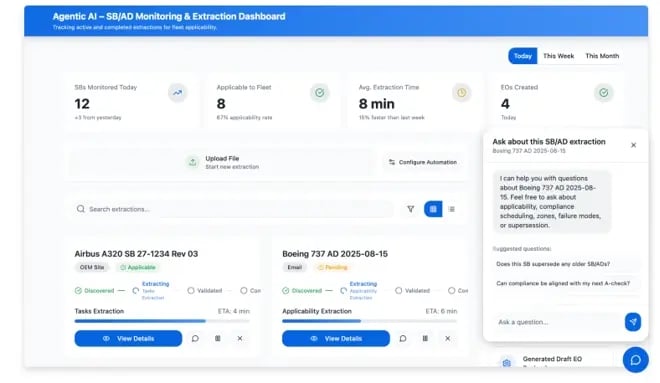
Instead of a 40-page PDF, engineers get a two-pane interface with the original document on the left and extracted, structured information on the right.
The agent automatically pulls out:
What took four days to extract now takes 30 minutes to review.
OEMs scatter effectivity data across pages using MSN ranges, serial numbers, manufacturing dates, and retrofit conditions.
Manual processing is error-prone. You either unnecessarily ground aircraft (cost) or miss an aircraft that should be compliant (safety risk).
The agent automatically handles these variations and converts them into accurate, system-ready data.
The agent does the heavy lifting, but engineers maintain full control. They review extracted information, make modifications if needed, and generate the Engineering Order with one click. It goes into Draft status automatically; allowing your approval workflows to complete before release.
The AI accelerates the work. The engineer owns the decision.
Engineers don't manually flip through pages.
They ask questions in plain language:
The system provides concise answers instantly instead of requiring 20 minutes of manual searching.
All processing is tracked through a centralized dashboard:
You have an audit trail for regulatory questions.
Service Bulletin and Airworthiness Directive processing has always been critical to aircraft safety and regulatory compliance, but the traditional approach has required engineers to spend significant time manually reviewing complex technical documents, validating applicability, and coordinating compliance actions.
With Agentic AI for Aviation Maintenance, this process becomes faster, smarter, and more predictable. An engineering team responding to an urgent fleet-wide SB no longer spends four days extracting information. Instead, they review structured data in 30 minutes, validate the findings, and move forward. SBs that once created week-long bottlenecks become manageable.
The impact goes beyond time savings. Airlines and MRO organizations benefit from reduced manual effort, faster engineering turnaround, improved accuracy, and greater scalability across growing fleets. The firefighting stops, workflows become predictable, and engineers can focus on engineering decisions rather than document processing.
Agentic AI does not replace engineering expertise. It strengthens it by handling repetitive, time-consuming tasks while keeping engineers in control of critical maintenance decisions. As aviation continues to become more complex, organizations that combine human expertise with intelligent automation will be better equipped to improve compliance, increase aircraft availability, and build safer, more resilient maintenance operations.
Agentic AI for Aviation Maintenance uses intelligent AI agents to automate complex aviation engineering workflows such as Service Bulletin (SB) processing, Airworthiness Directive (AD) compliance, document analysis, applicability assessment, and Engineering Order generation. Unlike traditional automation, Agentic AI can analyze technical documents, make recommendations, interact with engineering systems, and support decision-making while keeping engineers in control.
Agentic AI transforms SB and AD processing by automatically discovering new technical publications, validating aircraft applicability, extracting engineering requirements, identifying affected aircraft, analyzing compliance timelines, and converting unstructured OEM documents into structured maintenance data. This reduces manual document review time from days to hours while improving accuracy and compliance visibility.
Airlines can reduce Service Bulletin analysis time by using AI-powered document processing that automatically extracts key engineering information such as aircraft effectivity, modification requirements, spare parts, tooling, labor estimates, and compliance deadlines. Engineers can then review validated information instead of manually searching through lengthy OEM documents.
Yes. Agentic AI helps airlines improve Airworthiness Directive compliance by identifying affected aircraft, tracking regulatory requirements, extracting mandatory actions, and maintaining audit-ready records. By reducing manual interpretation errors and improving visibility into compliance status, airlines can minimize regulatory risk and avoid operational disruptions.
Agentic AI analyzes complex aircraft effectivity conditions including Manufacturer Serial Numbers (MSNs), aircraft configurations, production ranges, retrofit history, and previous modifications. It converts these complex rules into structured applicability data, helping engineering teams accurately identify affected aircraft and avoid both missed compliance actions and unnecessary maintenance events.
No. Agentic AI is designed to augment aviation engineering teams, not replace them. The AI performs repetitive tasks such as document analysis, data extraction, and information retrieval, while engineers continue to review recommendations, apply technical judgment, approve Engineering Orders, and make final maintenance decisions.
Agentic AI helps airlines and MRO organizations achieve faster engineering turnaround, reduced manual workload, improved compliance management, better maintenance planning, and increased aircraft availability. By automating time-consuming document processing tasks, engineering teams can focus on higher-value activities that improve operational efficiency and fleet reliability.
Aviation organizations should evaluate AI solutions based on data security, integration with existing MRO systems, regulatory compliance support, human-in-the-loop workflows, scalability across aircraft fleets, and the ability to provide transparent audit trails. The most effective Agentic AI solutions enhance existing engineering processes while maintaining operational control and accountability.