What is the core difference between component MRO and engine MRO?
Published :

| Key Takeaways: |
|
Aircraft maintenance is often discussed as a single domain. Operationally it splits into distinct disciplines, each with its own regulatory basis, data model and shop-floor rhythm. Two of them are frequently treated as interchangeable at the software level: component maintenance and engine maintenance. Both repair rotables, both issue airworthiness release documentation, both consume parts and labour. On the surface they look like variations of one workflow. Beneath the surface they are not.
A component shop receives a discrete, removable unit, such as a valve, an actuator, a pump, an avionics box, a wheel or a brake assembly. It inducts the unit against a single part number, performs a bounded repair against a Component Maintenance Manual, tests it and releases it with one authorised release certificate. The unit of work is the part. The bill of materials is shallow. The repair scope is largely known at induction.
An engine is a different kind of object entirely. It is not a part; it is a managed configuration of thousands of parts, many of them life-limited, assembled into modules, tracked individually by serial number or batch number, and governed by a continuously evolving stack of Engine Manuals, Service Bulletins, Airworthiness Directives and OEM work-scope planning guides. An engine shop visit is not the repair of one thing; it is the controlled disassembly, evaluation, repair, re-assembly and test of a serialised asset whose final scope is unknown until the engine is opened and inspected. The unit of work is the shop visit, and the shop visit is a project.
A growing number of carriers are insourcing engine maintenance, standing up dedicated shops to control turnaround time, cost and material flow on the CFM56, LEAP and similar high-volume engine families. As these programmes reach the software-selection stage, a tempting assumption surfaces: that a system already proven in component repair will naturally stretch to cover engine overhaul.
Each capability below is a process discipline native to engine overhaul. None is necessary to run a high-performing component shop, which is why a platform optimised for component repair has had no driver to develop them to depth. Where these capabilities appear in a component-oriented system at all, they tend to be approximations of fields and screens that resemble engine concepts without enforcing the underlying engine logic.
A component arrives with a defect and a known repair. An engine arrives with only a partly defined scope: the final work is determined after teardown and borescope inspection, weighed against the OEM work-scope planning guide and the operator's cost and performance targets. Engine MRO must support a formal work-scope build-up - factoring Service Bulletin impact, life-limited part disposition and target work-scope requirements that are created, revised and re-priced as findings emerge. Component systems have no equivalent because the scope is rarely in question. The opportunity for an engine shop is to make that build-up a controlled, costed, auditable activity rather than a spreadsheet running alongside the system.
Software capability needed to manage it: A configurable work-scope engine that ties planned and emergent tasks to teardown and inspection findings, supports iterative revision and re-pricing as the scope grows, and maintains a defined-versus-actual scope view that planners and customers can rely on throughout the visit.
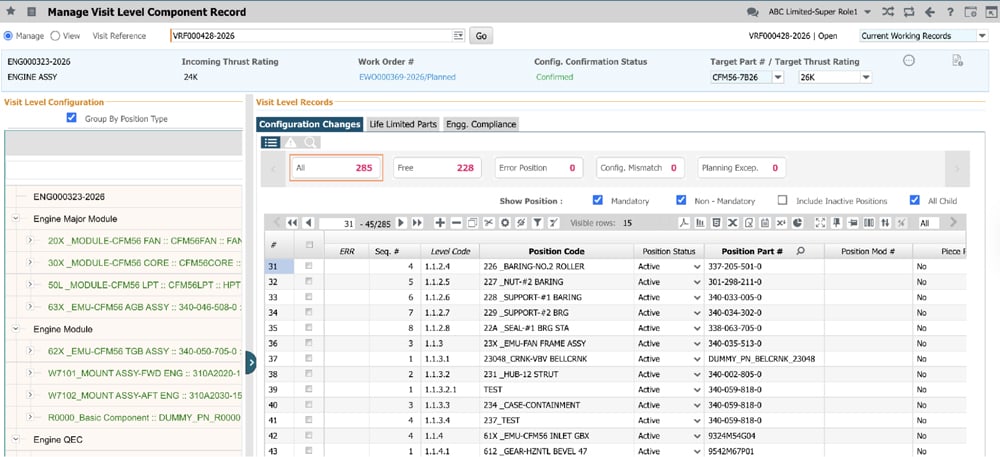
An engine is tracked as a live, multi-level configuration: engine to module to sub-module to individual serialised part, and down to piece-parts that carry no serial control. Every disc, spacer and seal must be tracked, its position in the build recorded, and its history preserved across multiple shop visits and multiple engines. The system must hold a complete as-removed and as-built record and reconcile the two at re-assembly. Scope follows configuration, and scope follows the part. That bidirectional coupling is fundamental to engine traceability and absent from component workflows.
Software capability needed to manage it: A multi-level serialised configuration model that holds engine, module, sub-module and piece-part structure together, captures as-removed and as-built states, enforces position and serial integrity at re-assembly, and preserves part history across visits and across engines.
Two material flows are routine in an engine shop and have no real counterpart in component repair. The first is exchange: to protect turnaround time and on-wing dates, engine shops constantly swap items from complete engines down to modules and individual life-limited parts. The second is scrap. When a disc, blade or case is condemned at inspection, it is not simply written off; it is a high-value, life-limited item that must be quarantined, formally dispositioned, certified as mutilated or destroyed, and recorded against its back-to-birth history so it can never re-enter the supply chain with a parallel replenishment trigger so the scrapped part does not put turnaround time at risk. A component shop scraps and exchanges at far lower value and granularity, with none of the serialised configuration, LLP-life and certified-destruction logic these flows demand.
Software capability needed to manage it: Integrated exchange and scrap handling with full life-limited part tracking, certified-destruction workflows, plus an automatic replenishment trigger on condemnation so turnaround time is protected the moment a part is scrapped.
When an engine is inducted it is exploded into thousands of piece-parts, each individually tagged, segregated, routed to specialised internal and external repair processes, and later reconciled back into the build. Individual parts follow divergent paths in-house machining, plasma spray, welding, plating and NDT, and out to external vendors for processes the shop does not hold, and each may visit several stations, each with its own certification, before returning. Engine MRO must orchestrate this many-to-many routing, track each piece-part through every step, and prevent a build from closing while any part is still in process. Crucially, when a part is removed and routed elsewhere, its work scope, task history and compliance requirements must travel with it. A component repair is overwhelmingly a single-unit, mostly in-house flow that never disassembles to this depth, so component systems are not architected to manage parts-in-process at this volume or granularity.
Software capability needed to manage it: Piece-part kitting and many-to-many routing across internal stations and external vendors, with individual part tracking through every process step, scope and compliance that travel with the part wherever it goes, and a build-closure control that blocks completion while any part is still in process.
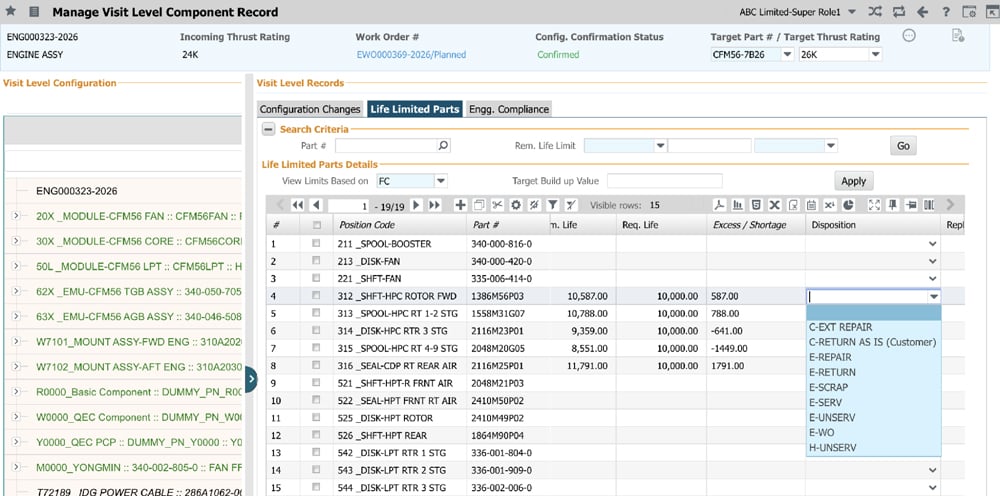
An engine shop visit is the moment when Service Bulletins are economically incorporated, and the choice of which to embody weighed against cost, downtime and remaining life is a planned, recorded engineering activity unique to the visit. Engine MRO must model SB applicability at part and configuration level, plan incorporation into the work scope, and prove embodiment in the build record. That feeds directly into execution: an engine shop floor must absorb constant change as inspection findings, awaiting-disposition decisions, work-scope upgrades, OEM task revisions, parts-on-order and sub-contract returns reshape the job daily. This is dynamic, exception-driven shop-floor control at a scale a component workflow never has to manage; a system whose execution model assumes a stable, pre-known scope does not bend to the way an engine shop actually runs.
Software capability needed to manage it: SB/AD applicability modelling at part and configuration level with planned incorporation into the work scope and proven embodiment in the build record, paired with an exception-driven execution layer that absorbs daily change from findings, dispositions, scope upgrades, parts-on-order and sub-contract returns.
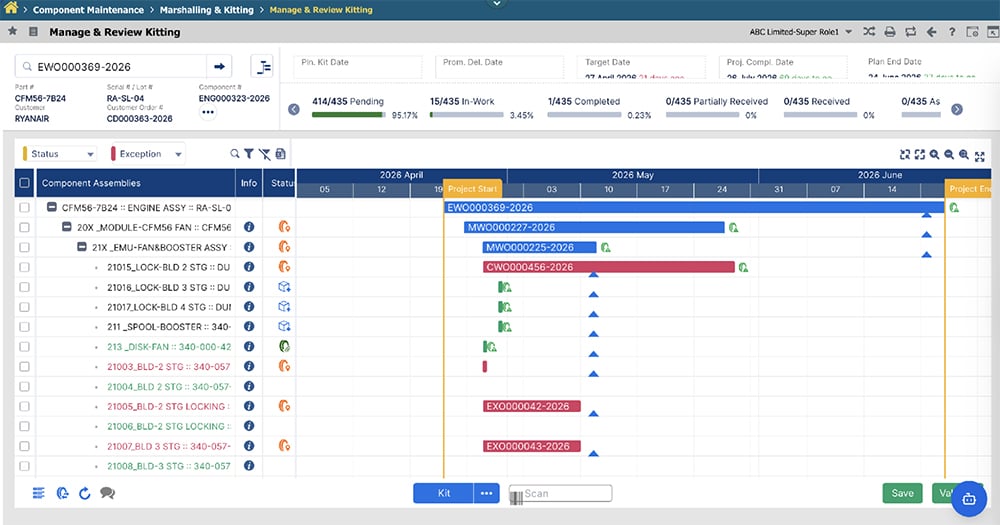
Three closing disciplines come together at the back of the shop. First, scheduling: engine shops are gated by scarce, expensive resources, test cells, clean rooms, balancing rigs, specialist skills, and a visit spanning many weeks must be scheduled against them while turnaround time is managed against contractual commitments, demanding project-style scheduling and critical-path visibility across a long event. Second, layered release: repaired piece-parts are released, modules are certified, and finally the complete engine is released to service, each layer with its own documentation and sign-off authority, all reconciling into one auditable record. Third, subcontract traceability: a large share of piece-part and module repair is sub-contracted, and parts that leave in bulk do not return as a matching set - some scrapped, some exchanged, some repaired, some returned with a Service Bulletin embodied so the item that comes back is not the configuration that went out. Every divergent outcome must be received, reconciled and dispositioned individually, yet stay tied to the parent engine work order so cost and turnaround time roll up correctly to the visit.
Software capability needed to manage it: Project-style, capacity-constrained scheduling with critical-path and bottleneck visibility across a multi-week event; a layered certification hierarchy spanning piece-part, module and complete-engine release; and subcontract repair-order management that reconciles divergent returns individually while rolling cost and turnaround time back to the parent engine work order.
| Area | Component MRO | Engine MRO |
|---|---|---|
| Unit of Work | Individual part or rotable component | Entire shop visit (engine as a serialised asset) |
| Scope at Induction | Clearly defined and mostly known | Evolving and often unknown until teardown and inspection |
| Configuration Management | Limited or single-level tracking | Multi-level serialised structure (engine, module, sub-module, piece-part) |
| Life-Limited Part (LLP) Tracking | Minimal or indirect | Critical for airworthiness, value, and compliance |
| Repair Routing | Linear, mostly in-house workflow | Many-to-many routing across internal stations and external vendors |
| Scheduling Model | Work order-based scheduling | Project-based, capacity and materials constrained shop visit scheduling |
| Release & Certification | Single unit release certificate | Layered certification (part, module, engine) with full reconciliation |
Component maintenance and engine maintenance are both essential, both demanding, and both deserving of purpose-built systems. They are not, however, the same process, and the assumption that proven component capability will satisfy engine requirements does not hold against the six disciplines set out above. Each is native to engine overhaul and absent from component repair precisely because it is unnecessary there.
The constructive path for any engine-shop programme is direct: treat engine-MRO capability as something to be proven in production, not inferred from adjacent component experience. A platform engineered for the engine - its configuration, its life-limited economics, its long-cycle project rhythm and its layered release- is not a preference. For a serious engine-shop investment, it is the lower-risk and ultimately the more economical foundation. The shops that build that foundation deliberately are the ones that will own their turnaround time, their cost and their material flow as engine insourcing accelerates.
Component MRO repairs a single removable part with a known repair scope and a simple configuration. Engine MRO manages a fully serialised asset made of multiple modules, where the final work scope is only confirmed after teardown and inspection. Engine MRO software must support configuration control, life-limited parts, and a project-based shop visit model.
Extending component MRO software to engine MRO is inefficient because engine overhaul requires capabilities such as serialised configuration tracking, LLP management, dynamic work scope, piece-part routing, SB embodiment, and project-based scheduling. Most component software are not designed for this level of engine-specific operational complexity.
Engine shops should evaluate MRO software using real production scenarios rather than demos. Key tests include work scope planning, serialised engine build tracking, LLP management, subcontract repair reconciliation, and shop visit scheduling. Strong engine MRO software must demonstrate these capabilities in live or reference engine shop operations.
Engine MRO software for efficient in-house MRO operations should include work scope management, serialised engine configuration tracking, LLP lifecycle management, Service Bulletin incorporation and shop visit scheduling. It must also support piece-part routing, exchanges, and subcontract coordination to control turnaround time, cost, and compliance in internal engine shops.
Engine MRO software improves turnaround time by enabling real-time work scope updates, better visibility of parts availability, and faster decision-making during teardown and inspection. It reduces delays through critical-path scheduling, LLP tracking, and coordination of internal and external repairs across the entire engine shop visit.