Does a Cloud Payroll Management System Comply with the Australian Privacy Act 1988?

Published :

Key Takeaways
Australian enterprises are moving payroll away from ageing local infrastructure and fragmented tools. That shift reflects pressure from regulatory change, business expansion and rising headcount. Deloitte’s 2025 Payroll Benchmarking Survey identifies these areas as major payroll cost drivers for large global organisations.
That adoption matters because cloud payroll changes more than the hosting location for payroll leaders. A payroll management system must now support STP Phase 2, Superannuation Guarantee, and Payday Super. It also needs wage records, security controls and employee access in one operating model.
This guide follows that operating view from selection to implementation. It explains how cloud-based payroll management systems in Australia work, which features matter and how leaders should plan migration. It also covers compliance authorities, AI-driven controls, data security and Ramco Payce’s role in enterprise payroll.
A cloud-based payroll management system is payroll software hosted by the provider and accessed through a secure online environment. It manages employee data, calculations, approvals, reports and access controls. It gives payroll teams one controlled workspace instead of relying on local servers.
Such a payroll management system supports modern payroll access, governance and reporting across distributed organisations.
Australian enterprises are moving to cloud payroll because compliance cycles now demand faster control and better evidence. A payroll management system must support remote access, statutory updates and multi-entity reporting. Local infrastructure can slow down those tasks when payroll deadlines are compressed.
The move to cloud-based payroll management systems in Australia should improve the operating model rather than simply transfer old workflows to a new platform.
A payroll management system should include compliance reporting, rule management, super handling, employee access and payroll analytics. Leaders should assess these features through real payroll scenarios. The strongest Australia payroll software solutions connect compliance, processing and reporting without adding extra manual work.
The feature set should make payroll easier to control before each pay run closes.
A strong Payroll Management System should therefore work as a control layer across the pay cycle. The best Australia payroll software solutions help teams act earlier, rather than discovering issues after payroll has already closed.
A cloud payroll system in Australia gives payroll teams faster access, managed updates and easier scalability than traditional on-premises tools. On-premises payroll can still support some organisations. Cloud platforms usually fit better when compliance updates, distributed teams and multi-entity controls create more pressure.
| Evaluation Area | On-Premises Payroll | Cloud Payroll Management System |
|---|---|---|
| Compliance Updates | Requires internal IT projects and testing cycles. | Provider releases updates on defined schedules. |
| Payday Super Readiness | May require system changes before July 2026. | Central updates can support faster readiness work. |
| Cost Model | Includes servers, licences, upgrades and recovery costs. | Uses recurring subscription or service-based pricing. |
| Access Flexibility | Often depends on office networks or VPN access. | Supports secure browser access across approved locations. |
| Disaster Recovery | Client manages recovery planning and testing. | Provider supports availability and recovery processes. |
| Reporting Scale | May rely on extracts and local tools. | Supports dashboards, workflows and shared data views. |
A cloud payroll management system should show how Australian regulators shape payroll responsibility. The ATO, FWO, FWC, state revenue offices and APRA each govern different obligations. The system should connect evidence across those obligations while employers keep final accountability. This improves response speed when audits or corrections arise.
These authority requirements meet inside every pay cycle, so evidence cannot sit across separate files. The Fair Work Ombudsman recovered $358 million for more than 249,000 underpaid workers during 2024-25, showing why payroll evidence matters.
AI is helping payroll teams move from broad manual checks to focused exception review. A payroll management system can compare current results against past patterns and expected values. This helps teams catch unusual overtime, duplicate allowances, missed deductions and sharp net-pay movements before approval.
AI also helps prioritise payroll exceptions by value, employee impact and compliance exposure. Payroll specialists still need to review material exceptions, confirm the reason and approve corrections. The employer remains accountable for the accuracy of final payroll and statutory reporting.
BInGO supports real-time analytics, report creation and payroll drill-down inside Ramco Payce. A modern payroll management software in Australia strategy should use AI for earlier detection, while keeping human oversight in the decision loop.
Payroll data contains TFNs, bank details, salary records, leave history and identity information. A Payroll Management System must protect this data through controlled access, encryption, audit logging and clear hosting terms. Buyers should review these commitments before selecting an online payroll system in Australia.
Security should be part of the payroll evaluation process because payroll data carries financial, privacy, and employee trust risks. The OAIC received 532 data breach notifications from January to June 2025, with malicious or criminal attacks causing 59%.
A strong payroll management system should make these controls visible during procurement and audit reviews. Payroll buyers should treat security as a core operating requirement, not a technical appendix reviewed after platform selection.
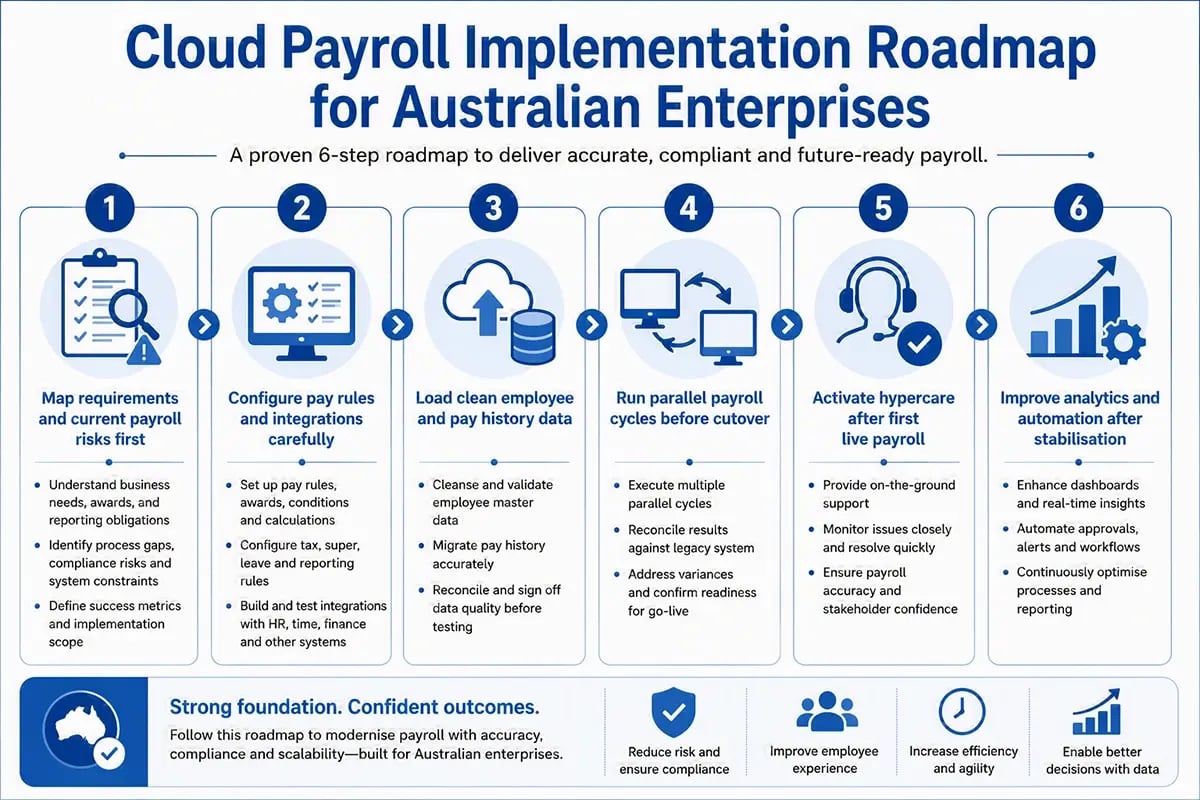
Cloud payroll migration can fail when teams treat the project as a technical upgrade. A payroll management system touches employee data, rules, approvals, finance records and reporting duties. Leaders should address operating risks before they affect the first live payroll.
These pitfalls are manageable when leaders define ownership before configuration starts. Clean data, parallel testing and vendor due diligence help the new payroll management system improve control from the first live cycle.
Australian enterprises need STP accuracy, award support, Payday Super readiness, wage evidence and payroll visibility inside one cloud platform. At Ramco, we built Ramco Payce to connect payroll processing, analytics, employee access and compliance workflows.
Payroll Workspace supports operational control through activity views, tasks, anomalies and reporting. Daily HR supports employee access to payroll and HR information, while BInGO helps leaders explore payroll data without heavy manual extraction.
Ramco Payce supports payroll across 150+ countries and 500+ customers. These capabilities help Australian enterprises manage local requirements while supporting regional or global payroll operations through one payroll management system.
Book a Ramco Payce enterprise payroll consultation.
A cloud payroll management system can support Privacy Act compliance through security controls, access permissions, encryption, audit logs and defined data handling processes. However, employers remain responsible for how employee personal information is collected, used and protected. Organisations should review vendor contracts, data processing terms, breach response procedures and audit rights before selecting a payroll platform.
If a cloud payroll vendor experiences a data breach, employers and providers must follow applicable breach response obligations under the Notifiable Data Breaches scheme. Organisations should understand notification responsibilities, evidence access requirements and escalation processes before implementation. A strong payroll management system should provide monitoring, audit trails and security controls to support faster investigation and response.
Yes, modern cloud payroll management systems can integrate with HRIS, workforce management, time and attendance, finance and ERP platforms through APIs or standard connectors. Integration planning should define data ownership, validation rules, reconciliation processes and exception handling before migration. This helps reduce duplicate data entry and improves payroll accuracy.
Cloud payroll providers typically release updates based on legislative changes, regulatory requirements and platform improvements. Australian payroll systems may require updates for STP changes, Fair Work decisions, superannuation rate changes, payroll tax requirements and reporting obligations. Buyers should understand the provider’s update process, testing approach and release governance before selecting a platform.
Cloud payroll management systems require internet access because the platform operates online. However, enterprise providers usually design platforms with availability, backup and recovery controls to reduce disruption risk. Payroll teams should also maintain contingency procedures, escalation contacts and critical payroll access plans for unexpected outages.
The total cost of ownership for cloud payroll includes software subscription fees, implementation, integrations, support, security, upgrades and ongoing administration. Businesses should compare these costs against maintaining legacy payroll infrastructure, including internal IT support, manual processes and compliance risks. A suitable payroll management system should reduce operational effort while improving control.
A cloud payroll management system supports STP Phase 2 by validating employee earnings, income types, PAYG withholding details, employment information and reporting data before submission to the ATO. Payroll teams should still review classifications, tax treatment codes and year-to-date values to ensure accurate reporting.
Yes, cloud payroll software can help employers prepare for Payday Super by connecting payroll calculations, superannuation obligations, payment workflows and reconciliation processes. From 1 July 2026, employers will need faster validation and exception management because super contributions must reach employee funds within seven business days after payday.
Cloud payroll software can provide strong security through encryption, role-based access controls, multi-factor authentication, monitoring and audit logging. Because payroll systems store sensitive information such as tax details, bank information and salary records, organisations should evaluate vendor security practices, certifications and incident response processes before implementation.
An enterprise cloud payroll management system should include STP reporting, award interpretation, superannuation processing, multi-entity payroll support, employee self-service, workflow approvals, analytics, audit trails and integration capabilities. Leaders should evaluate each feature against real payroll scenarios rather than only reviewing software functionality lists.
Businesses can migrate to cloud payroll by preparing clean employee data, mapping payroll rules, reviewing integrations, testing compliance settings and running parallel payroll cycles before go-live. Successful migration requires collaboration between payroll, HR, finance, IT and the implementation team to reduce disruption.
AI improves payroll compliance by identifying unusual payroll movements, recurring errors, missing approvals and data inconsistencies before final payroll approval. AI-driven insights help payroll teams prioritise high-risk exceptions, although payroll professionals must continue reviewing, approving and documenting important decisions.