What Is Payroll Outsourcing?
Published :

Payroll outsourcing helps Australian businesses manage growth by adding specialist capacity for ATO, Fair Work, super and payroll tax compliance across multiple entities and locations. It strengthens payroll continuity, security and leadership oversight while internal teams retain final approval on every pay outcome. With Payday Super requiring faster, more accurate pay-cycle controls, outsourced payroll solutions combined with AI-assisted review help catch exceptions earlier. Platforms like Ramco Payce connect managed payroll delivery with real-time visibility, making expansion-ready payroll scalable across entities and countries.
| Key Takeaways: |
|
Business expansion creates opportunity, yet it also increases payroll inputs, approvals, pay groups and reporting work across every cycle. New employees, locations, awards and entities can stretch internal teams before leaders recognise the growing operating strain. Payroll outsourcing services can add specialist capacity while leaders retain clear responsibility for every pay outcome.
Australia recorded 2,729,648 actively trading businesses at 30 June 2025, including 994,178 employing businesses, according to the ABS. As employing businesses add headcount or new regions, payroll teams must coordinate more rules. They must also protect payment accuracy, evidence quality, service continuity and executive oversight.
This guide explains why payroll outsourcing supports expansion, how it strengthens compliance and what leaders should plan next. It also examines continuity, security, service governance, AI-assisted review and cross-border growth with a reliable platform like Ramco Payce.
Payroll outsourcing matters because expansion can increase payroll complexity faster than internal teams can absorb it. New locations, employees, entities and awards create more inputs, decisions, deadlines and evidence requirements. The right model adds operating capacity while protecting compliance, continuity, service quality and leadership oversight.
Expansion makes internal payroll harder because every new worker type or location adds different inputs, approval paths and pay rules. When the same team handles higher volumes through unchanged manual processes, correction risk grows. Payroll close also becomes harder to control across every expanding business unit.
Underpayment exposure seldom begins with one isolated payroll calculation or classification decision. Classification gaps, outdated award settings, weak approvals and incomplete records can allow errors to repeat. The Fair Work Ombudsman recovered $358 million for more than 249,000 workers during 2024–25. This result shows why payroll governance needs sustained leadership attention.
Payroll outsourcing becomes relevant when internal capacity cannot match the pace of organisational change. A provider can add specialist review, repeatable controls, structured evidence and clearer escalation paths. Leaders still own classifications, source data, approvals and workforce decisions throughout every growth cycle.
Outsourcing the process significantly improves Australian payroll compliance when expert review works through controlled processes and reliable evidence. Employers need aligned support for tax reporting, wage rules, super obligations and privacy controls. Clear ownership helps teams resolve exceptions before regulators or employees discover repeated problems.
| Authority | Compliance Area | What Payroll Outsourcing Should Support |
|---|---|---|
| ATO | STP Phase 2 and PAYG withholding; Payday Super and SuperStream changes | Valid pay-event reporting, super validation, payment evidence and correction tracking |
| Fair Work Ombudsman | Modern awards and enterprise agreements; underpayment evidence and remediation | Pay-rule review, exception checks, record quality and correction support |
| APRA | Super fund prudential settings and operational resilience | Accurate contribution data and prompt handling of fund responses |
| State Revenue Offices | Payroll tax thresholds and grouping rules | Wage allocation, threshold tracking, entity reporting and reconciliation evidence |
| OAIC | Employee privacy and breach response | Access controls, audit logs, retention rules and incident procedures |
Strong payroll outsourcing services should show compliance status before issues reach regulators or employees. Leaders need timely evidence, named owners and documented actions for every material exception across entities.
Manual compliance becomes harder when expansion increases rules, deadlines, payroll evidence and correction volumes. Payroll outsourcing changes the operating model when specialist service teams work beside automated checks and documented accountability. Technology should strengthen professional judgement rather than weaken final approval controls.
| Compliance Area | Manual Payroll Compliance | Payroll Outsourcing With Automation |
|---|---|---|
| Rule Updates | Internal teams track changes across separate sources | Providers map changes into controlled review workflows |
| STP Reporting | Teams repeat file checks and investigate errors manually | Controlled pay-event workflows support validation and correction |
| Payday Super | Corrections can consume the seven-business-day payment window | Automated checks support earlier exception handling and evidence |
| Audit Evidence | Teams rebuild decisions after regulators request records | Recorded actions preserve approvals and correction history |
| Continuity | Critical knowledge can remain with few specialists | Service teams support repeatable delivery and documented cover |
From 1 July 2026, employee funds must receive super guarantee contributions within seven business days after payday.
Effective payroll management outsourcing combines automation with specialist review across controlled payroll processes. Internal leaders approve payroll results, resolve workforce decisions, govern service performance and review material risks throughout each pay cycle.
Growing businesses should choose a payroll outsourcing model based on operational complexity, internal capacity, compliance exposure and desired control. The right model defines provider responsibilities, internal approvals, escalation ownership and reporting expectations. Leaders should compare service boundaries before they compare provider names or commercial terms.
Each option supports a different balance between service capacity and internal control.
Payroll outsourcing supports multi-entity expansion by standardising control while preserving entity-specific rules. Separate ABNs, pay calendars, awards and approval structures can fragment group reporting. Leaders need consolidated visibility without forcing every business unit into the same local process or weakening accountable entity ownership.
International growth adds local filings, currencies, labour rules and employee expectations. Global payroll outsourcing can connect local delivery with central governance when Australian headquarters need comparable reporting across countries. This approach preserves local expertise while giving leaders one view of service performance and unresolved exposure.
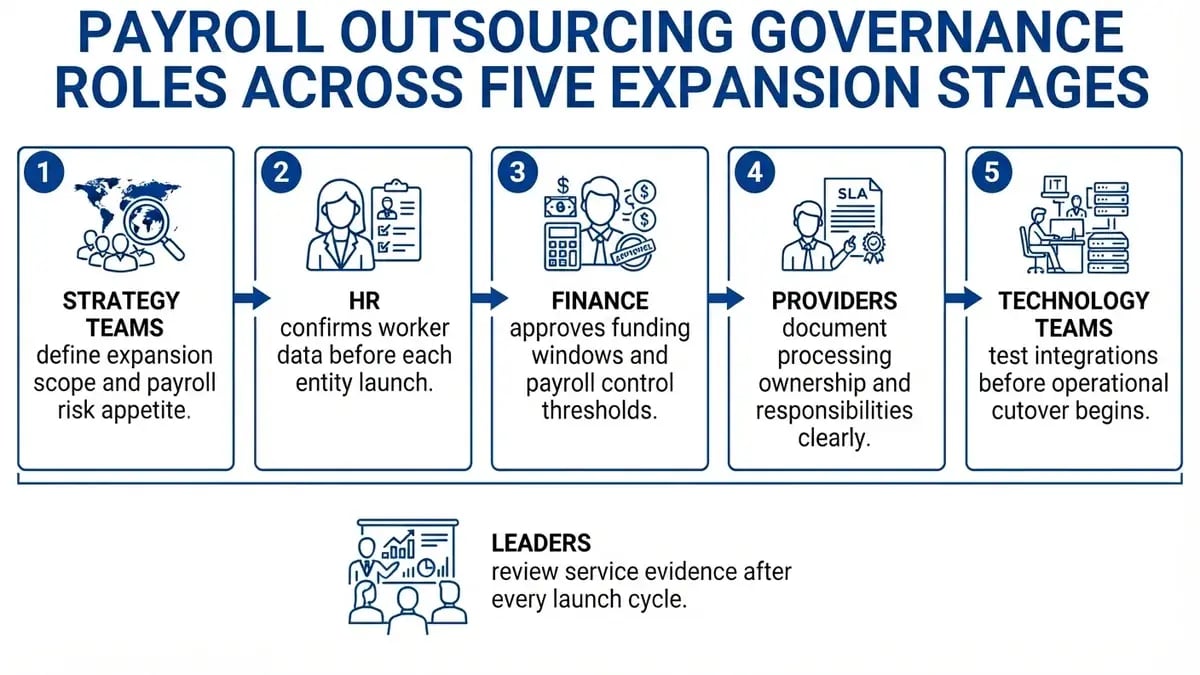
Expansion-ready providers should define service ownership, escalation routes, issue reporting and country-level evidence before each entity launches. Teams should also test integrations, payroll calendars, funding steps and approval deadlines. Global payroll software in Australia can support consolidated oversight as acquisitions or new markets enter the operating model.
Outsourced payroll solutions improve visibility, security and continuity when service teams and systems strengthen control together. Payroll data contains sensitive employee information and supports fixed payment deadlines. Leaders need evidence that outsourcing improves oversight instead of creating a distant operational dependency.
These controls show whether the service model protects daily operations as workforce scale and complexity increase.
Effective payroll outsourcing should strengthen data control while keeping accountability visible across internal teams and provider operations throughout every pay cycle.
Also Read: Need of Outsourced Payroll Services for ANZ Enterprises
AI and automation strengthen payroll outsourcing when they identify exceptions, compare variances and support routine queries before payroll closes. These tools improve service quality when payroll experts review sensitive outcomes and leaders approve decisions affecting employees. Automation should support judgement rather than replace accountability within each controlled pay cycle.
The strongest use cases of payroll outsourcing improve early visibility without obscuring decision ownership.
Broader finance adoption supports this direction, although leaders still need disciplined value measures. Gartner reported that 45% of finance AI investments leaned towards productivity while 20% leaned towards decision quality in 2026.
Australian leaders should compare payroll outsourcing providers through service depth, technology capability, compliance evidence and governance design. The selected model must match workforce complexity and expansion plans. Brand recognition cannot replace clear ownership, measurable controls, dependable reporting or tested continuity.
| Evaluation Area | What Leaders Should Ask | Why It Matters |
|---|---|---|
| Service Scope | Which payroll activities will the provider manage? | Prevents ownership confusion during each pay cycle |
| Compliance Support | How will specialists track ATO and Fair Work changes? | Reduces exposure from outdated rules or weak evidence |
| Technology Layer | What platform visibility will leaders receive? | Improves oversight across entities and service teams |
| Security Model | How will the provider protect sensitive payroll information? | Supports privacy governance and incident readiness |
| Expansion Fit | Can the model support new entities or countries? | Protects continuity during acquisitions and market entry |
| Reporting Quality | Which service measures and payroll insights are available? | Strengthens executive review and provider accountability |
Effective payroll outsourcing for growing businesses should increase capacity and evidence without reducing leadership control. Procurement teams should test service claims against realistic payroll scenarios before selection and contracting.
Ramco Payce supports payroll outsourcing by combining managed payroll expertise with enterprise payroll technology. We help Australian organisations manage pay runs, compliance workflows, employee queries and reporting through one connected operating model. Our Managed Services add capacity while internal leaders retain approval and governance responsibility across every payroll cycle.
We help payroll teams maintain control as transaction volumes and organisational complexity increase. Payroll Workspace brings pay runs, exceptions, approvals and outstanding tasks into one view. This visibility helps teams identify unresolved issues earlier and keeps leadership informed before each payroll reaches final approval.
BInGO adds deeper analysis when finance leaders need answers across entities or pay groups. Teams can review payroll trends, investigate unusual movements and understand cost changes without relying on repeated spreadsheet extraction. Together, these capabilities help growing companies improve payroll visibility while preserving clear review and approval responsibilities.
Build payroll operations with Ramco Payce to strengthen compliance, continuity, visibility and expansion readiness across every growth stage.
Book a free demo today to start exploring our payroll outsourcing solutions.
Payroll outsourcing is the practice of engaging an external payroll provider to manage some or all payroll activities on behalf of a business. Depending on the service model, this can include payroll processing, compliance support, superannuation processing, reporting, employee queries and payroll technology. Internal leaders can retain responsibility for source data, workforce decisions, approvals and overall payroll governance.
Payroll outsourcing supports business expansion by adding specialist capacity as employee numbers, locations, entities and payroll requirements increase. It can help businesses manage new pay groups, awards, reporting requirements and approval workflows without placing all operational pressure on a small internal payroll team. With the right technology and governance, outsourced payroll can also provide visibility across Australian and international operations as the business grows.
Payroll outsourcing can reduce Fair Work underpayment risk when providers support award interpretation, pay-rule review, exception handling and reliable payroll records. Businesses still remain responsible for employee classifications, employment arrangements, source data and final approvals. Leaders should review recurring payroll variances, document corrections and maintain appropriate oversight throughout each pay cycle.
Payroll outsourcing can support Payday Super compliance by coordinating contribution data, payment processing, validation, payment evidence and exception follow-up. From 1 July 2026, employers must ensure super contributions are received by an employee’s fund within seven business days of payday. A payroll provider can help monitor payment status, rejected transactions and corrections, while employers remain responsible for accurate information and timely compliance.
Yes, payroll outsourcing can be suitable for multi-entity businesses when providers can manage separate ABNs, pay calendars, approval workflows, awards and reporting requirements. A strong service model should also provide consolidated visibility across entities while preserving entity-level accountability. This helps growing businesses standardise payroll controls without forcing every entity into an identical local process.
Businesses can start by outsourcing payroll activities that create the greatest operational pressure or compliance risk. Common starting points include payroll processing, calculation review, STP reporting, super processing, reconciliation and employee payroll query support. Leaders should prioritise activities that repeatedly create corrections, missed deadlines, weak evidence or dependence on a small number of internal specialists.
CFOs should measure payroll outsourcing ROI through cost, efficiency, risk and service metrics. Useful measures include payroll processing time, correction volumes, rework hours, compliance exceptions, audit effort, employee query volumes and escalation ageing. CFOs should also assess whether outsourcing reduces specialist dependency and allows payroll capacity to scale without increasing internal resources at the same rate as business growth.
Buyers should ask payroll outsourcing providers how they manage access controls, encryption, authentication, audit logs, data retention and incident response. They should also confirm where payroll data is stored, who can access it, whether subcontractors are involved and how data is deleted or returned when services end. These questions help businesses assess whether the provider's security controls align with their privacy and governance requirements.
Businesses should compare payroll outsourcing providers based on service scope, Australian compliance capability, technology, security, reporting, scalability and governance. Buyers should clarify who owns each payroll activity, how exceptions are escalated, what visibility leaders receive and how the provider will support new entities or countries. Testing providers against realistic payroll scenarios can help businesses assess whether the proposed service model can support growth without reducing payroll control.