














8 Best Affordable Payroll Software in Australia for STP Compliance
TL;DR
This guide compares eight affordable payroll software platforms in Australia: Ramco Payce, Reckon, MYOB, Xero, Employment Hero, CloudPayroll, Deputy and Tanda. It evaluates their STP Phase 2 capabilities, pricing structures, employee limits, award configuration, integrations and suitability for different workforce sizes. It also examines payroll compliance responsibilities, Payday Super requirements effective from 1 July 2026, implementation costs, data security and AI-assisted payroll exception management. The key takeaway is to assess total operating costs and future workforce complexity, not just subscription prices. Ramco Payce offers a scalable option for growing mid-market businesses managing complex payroll requirements.
Introduction:
Australia has around 2.73 million actively trading businesses as of June 2025, and payroll obligations apply to every employer within that number. Growing businesses need accessible payroll technology that meets ATO reporting standards without adding operational overhead across every pay cycle.
The lowest monthly price does not always translate to the lowest operating cost. Employee limits, award configuration, correction effort, add-on modules and support charges shape the total expense of running payroll accurately across the year for any Australian employer.
This article compares eight of the best payroll software for STP in Australia across affordability, STP capability, growth fit and operating effort. While software can support compliance, employers bear the final responsibility for accurate pay and reporting when using single touch payroll software in Australia.
Key Takeaways
- Evaluate total payroll costs: Consider subscriptions, implementation, training, support, migration and future employee costs when comparing affordable payroll software in Australia.
- STP does not guarantee payroll compliance: Employers remain responsible for accurate pay calculations, employee classifications, reporting categories and ATO submissions.
- Test award configuration before implementation: Validate overtime, allowances, leave, terminations and other employee scenarios to identify payroll calculation gaps.
- Prepare for Payday Super: From 1 July 2026, payroll systems must support payday super payments, payment visibility, reconciliation and exception management.
- Prioritise scalability, security and auditability: Choose payroll software that supports workforce growth, multiple entities, secure employee data, approval workflows and reliable audit records.
How Does an Affordable STP Payroll Software Work?
Affordable payroll software for STP in Australia balances subscription costs with the effort required to process, validate, review, and correct payroll. Growing businesses should compare employee limits, integrations, award setup, support, migration and replacement risk before subscribing.
- Subscription Structure: Compare base charges, employee tiers, pay-run fees and compulsory modules before estimating annual cost. Marketing prices often exclude features that most Australian employers need in practice.
- Configuration Effort: Assess the time required for awards, allowances, leave rules and STP categories. Complex setups can consume weeks of internal capacity that no subscription price reflects.
- Operating Workload: Estimate manual checking, employee queries, correction processing and reconciliation work across every cycle. This workload sits behind every payroll platform, whether the STP-compliant payroll software is cheap or expensive.
- Growth Cost: Check whether new entities, locations, or international employees require a different platform or an expensive reimplementation. Payroll replacement carries data migration, retraining and parallel-run costs alongside the new subscription.
These costs explain why a payroll system upgrade for growing businesses can become necessary before familiar workarounds constrain payroll control.

How Does Manual Payroll Compliance Compare With Automated STP Software?
Manual payroll relies on people to identify each missing record, incorrect code and reporting failure. Automated STP controls bring validation closer to the original event, though qualified reviewers retain responsibility for employee pay and statutory submissions.
| Compliance Area | Manual Payroll Approach | Automated STP Control |
| Employee Data | Spreadsheet and email checks | Required-field validation |
| STP Categories | Manual pay-code mapping | Configured reporting categories |
| Submission Review | Separate portal checking | Lodgement and rejection status |
| Corrections | Manual year-to-date adjustments | Guided update events |
| Super | Periodic spreadsheet reconciliation | Pay-cycle liability tracking |
| Audit Evidence | Records collected after events | Timestamped system history |
Payroll control now carries higher legal consequences for Australian employers and responsible officers. The Fair Work Ombudsman confirms that intentional underpayment became a criminal offence on 1 January 2025, while honest mistakes remain excluded. Individuals can face up to ten years’ imprisonment under the legislation.
What Are The 8 Best Affordable Payroll Software STP Platforms In Australia?
The best STP payroll platforms in Australia vary by workforce size, award complexity, accounting systems and future growth plans. Here is a quick overview of the affordable payroll software in Australia for growing enterprises:
| Platform | Australian Compliance Functionality | Primary Fit |
| Ramco Payce | ATO-whitelisted STP with controlled Australian payroll workflows | Growing mid-market and complex groups |
| Reckon Payroll | STP Phase 2, PAYG and super calculations included | Micro and small businesses |
| MYOB Payroll Only | Direct ATO reporting with automated tax and super | Micro employers |
| Xero Payroll | STP reporting with PAYG, super and leave calculations | Accounting-led small businesses |
| Employment Hero Payroll | STP Phase 2 with connected Australian HR workflows | SMEs wanting HR and payroll |
| CloudPayroll | STP reporting with Australian payroll and self-service | Small and growing employers |
| Deputy Payroll | STP Phase 2 linked with approved workforce data | Shift-based Deputy customers |
| Tanda Payroll | STP reporting with Australian award interpretation workflows | Hourly and award-heavy businesses |
Now, let’s undertake a detailed comparison of the best STP payroll platforms in Australia:
1. Ramco Payce
Ramco Payce supports growing mid-market organisations adding entities, pay groups, approval layers or international operations. It combines Australian processing with operator visibility and managed delivery choices. This design reduces replacement risk when payroll software for STP in Australia must handle greater complexity.
Payce targets long-term operating value for organisations facing greater payroll complexity. Payroll Workspace gives operators visibility across active runs, tasks, approvals and exceptions within the wider platform.
Who Is Ramco Payce Best For?
Ramco Payce suits growing mid-market and larger businesses expecting entity growth, additional pay groups, complex workforce rules or international expansion. Organisations can choose software-led processing or add managed support where internal payroll capacity becomes constrained.
What are the Pros and Cons of Ramco Payce?
| Benefits | Considerations |
| Scales across entities and countries | Quote-based pricing requires direct provider consultation |
| Shows active payroll runs clearly | Implementation needs structured data and process planning |
| Offers software and managed delivery |
How Does Ramco Payce Balance STP Affordability And Growth?
Ramco Payce offers long-term value where growth requires stronger control, entity separation, international coverage or managed support. Its Australian payroll software includes ATO-whitelisted STP capability, while employers retain responsibility for classifications, source data and approvals.
2. Reckon Payroll
Reckon Payroll is available via mobile and web, with employee-tiered pricing for Australian small businesses. The platform covers STP Phase 2, PAYG withholding and super calculations across every pay cycle. Its plans use employee tiers, covering up to four, up to ten, or larger teams.
Who Is Reckon Payroll Best For?
Reckon suits micro and small businesses seeking payroll software for STP in Australia with predictable employee tiers. It also provides mobile access without requiring a wider accounting subscription.
What are the Pros and Cons of Reckon Payroll?
| Benefits | Considerations |
| Public pricing aids initial budgeting | Advanced workforce tools may require other systems |
| Mobile access suits business owners | Complex awards need careful configuration and review |
How Does Reckon Keep STP Costs Predictable?
Employee-tiered plans support annual budgeting by capping the maximum charge for the covered workforce. Buyers should compare standard published pricing rather than temporary discounts and confirm the current rate before signing up.
3. MYOB Business Payroll Only
MYOB Business Payroll Only provides standalone payroll for up to four employees at a fixed monthly rate. The plan connects direct ATO reporting with automated tax, super and leave calculations inside the payroll workflow.
Who Is MYOB Payroll Only Best For?
MYOB suits micro employers who need focused payroll software for STP in Australia without adopting a broader HR platform. The four-employee limit makes careful future headcount planning especially important.
What are the Pros and Cons of MYOB Business Payroll Only?
| Benefits | Considerations |
| Low price for small teams | Payroll-only plan covers four employees maximum |
| Direct ATO reporting within pay runs | Growth may require another MYOB subscription |
How Does MYOB Fit Micro-Employer STP Requirements?
The fixed employee limit creates straightforward value for very small teams. Expanding employers should compare the next MYOB plan before making a selection, because crossing the limit changes the product and cost decisions.
4. Xero Payroll
Xero Payroll is available within selected Australian accounting subscriptions, with employee allowances that vary by plan. The platform connects payroll journals, employee self-service and STP reporting with the wider accounting environment familiar to many Australian businesses.
Who Is Xero Payroll Best For?
Xero suits small businesses that already use its accounting platform and manage relatively straightforward payroll rules. Existing accounting value can make the combined subscription more economical.
What are the Pros and Cons of Xero Payroll?
| Benefits | Considerations |
| Payroll journals connect with accounts | Employee allowances vary across subscription tiers |
| Xero Me supports employee self-service | Subscription includes wider non-payroll functionality |
When Does Xero Payroll Remain Cost-Effective?
Xero payroll software for STP in Australia offers stronger value when the business already needs Xero accounting. Buyers should model planned headcount carefully, as additional payroll charges may apply beyond each plan’s included employee allowance.
5. Employment Hero Payroll
Employment Hero Payroll connects payroll with employee records, leave management and wider HR workflows. The platform gives Australian SMEs an accessible option when they want fewer handoffs between systems across their employment operations.
Who Is Employment Hero Payroll Best For?
Employment Hero suits SMEs seeking payroll software for STP in Australia alongside connected HR workflows. It can also suit teams considering managed processing after internal capacity becomes limited.
What are the Pros and Cons of Employment Hero Payroll?
| Benefits | Considerations |
| HR and payroll use connected employee data | Final cost depends on selected package scope |
| STP Phase 2 supports detailed reporting categories | Some services involve separate processing charges |
How Does Connected HR Affect Payroll Value?
Connected employee information can reduce repeated data handling across onboarding, time capture, leave and payroll. Buyers should compare the full package, HR modules, super processing charges and managed service scope rather than the headline price alone.
6. CloudPayroll
CloudPayroll provides Australian cloud payroll software with pay-run pricing that varies by employee count and payroll frequency. The platform includes employee self-service, reporting and outsourced service options for smaller and growing employers.
Who Is CloudPayroll Best For?
CloudPayroll suits small and growing employers seeking payroll software for STP in Australia with self-service, reporting, support and optional outsourced processing.
What are the Pros and Cons of CloudPayroll?
| Benefits | Considerations |
| Transparent pay-run pricing aids cost estimates | Frequent pay runs can increase annual costs |
| Employee Kiosk supports self-service | Setup fees may apply during migration |
How Does Pay-Run Pricing Affect Affordability?
Headcount and pay frequency determine CloudPayroll’s annual cost across each financial year. Employers face more pay-run charges each week, so buyers should model their actual schedule before comparing totals.

7. Deputy Payroll
Deputy Payroll connects approved timesheets, award interpretation and payroll inside the wider Deputy workforce platform. The payroll product requires an active Deputy environment where rosters and time tracking already sit.
Who Is Deputy Payroll Best For?
Deputy suits shift-based employers already using its roster and time tools. As payroll software for STP in Australia, it can reduce exports and reconciliation between workforce records and payroll.
What are the Pros and Cons of Deputy Payroll?
| Benefits | Considerations |
| Approved timesheets enter payroll directly | Payroll requires the wider Deputy platform |
| Workforce data stays within one environment | Product has a shorter Australian operating history |
When Does Integrated Shift Payroll Reduce Total Cost?
Direct timesheet-to-payroll flow may reduce manual exports and repeated checking. Buyers should compare the combined workforce and payroll subscription against separate products, including any award configuration and implementation effort.
8. Tanda Payroll
Tanda Payroll focuses on hourly and shift-based Australian workforces. The platform integrates rostering, timesheets, award interpretation, and STP reporting into a single operating environment that covers payroll and workforce management.
Who Is Tanda Payroll Best For?
Tanda suits hospitality, retail, healthcare and service employers with award-heavy workforces. This payroll software for STP in Australia adds value when hours and pay conditions require close connection.
What are the Pros and Cons of Reckon Payroll?
| Benefits | Considerations |
| STP lodgement operates within payroll | Custom agreements still need careful configuration |
| Workforce tools support operations | Office teams may need less workforce functionality |
When Does Award Automation Improve Payroll Value?
Award automation creates value when shift complexity would otherwise require extensive manual calculations. Employers should test actual employees and enterprise agreements, because templates may not cover every custom arrangement or local condition.
How Can AI Improve Payroll Compliance Without Replacing Reviewers?
AI can compare payroll results, prioritise unusual changes and support faster investigation across large workforces. Payroll specialists should still confirm workplace rules, approve corrections and control final STP submissions across every reporting cycle.
- Anomaly detection can highlight unexpected net-pay changes before payroll approval reaches the operator.
- AI-assisted validation can identify missing employee fields or unusual pay-code combinations across the pay run.
- Exception ranking can focus reviewers on payroll issues carrying greater financial exposure at cycle end.
- Recorded reasoning can strengthen evidence for correction and later compliance investigations across audit reviews.
PayrollOrg 2025 research shows that 21% of organisations already use AI within global payroll operations, and another 30% expect to introduce it. Ramco Payce runs its own AI payroll automation capability, which addresses the growing review pressure that internal teams face during large-population pay runs.
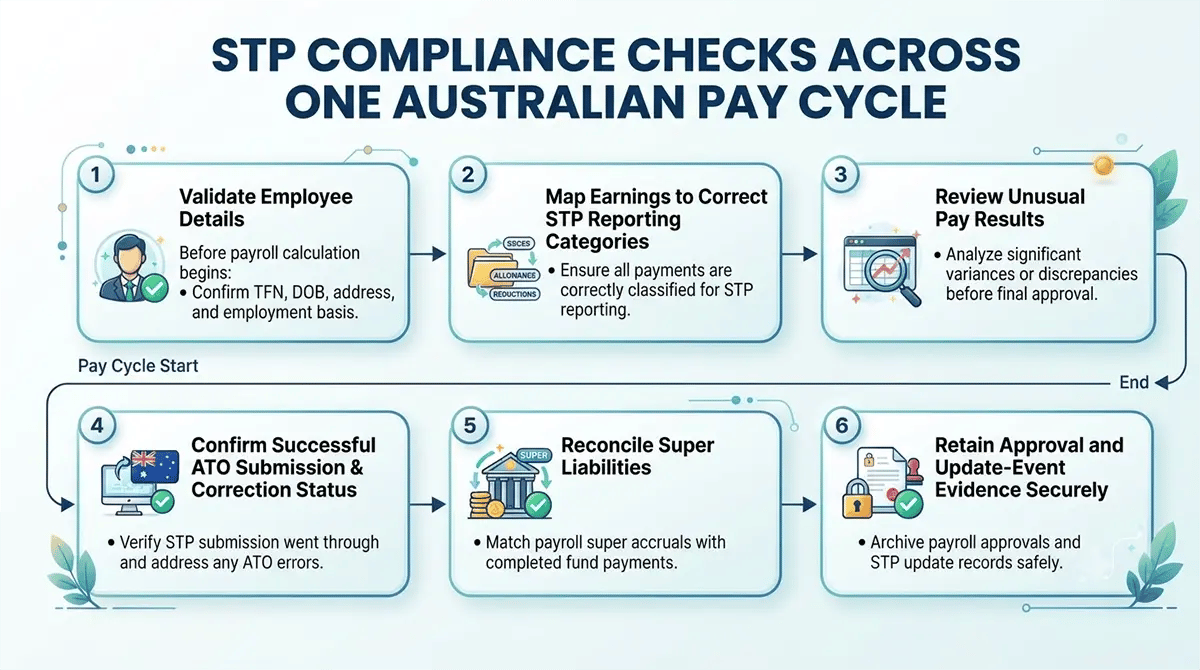
How Should Growing Businesses Choose An Affordable STP Platform?
Growing businesses should choose payroll software for STP in Australia by testing future costs and difficult scenarios. Reviews should cover employee growth, award complexity, Payday Super, support, security and data portability.
- Model subscription costs against expected employee growth over three years across every applicable pricing tier.
- Test actual award, overtime, termination and correction scenarios using representative employees from your workforce.
- Confirm Payday Super calculation, rejection and reconciliation workflows using the current Payday Super readiness framework as the checkpoint.
- Review support availability during payroll cut-off and year-end finalisation across weekends and public holidays.
- Test complete data export before signing the provider contract to protect future portability.
Several cloud payroll software in Australia store banking, identity and pay information, which places them within the scope of the Notifiable Data Breaches scheme. The OAIC reported 1,113 data breach notifications during 2024, and payroll platforms should fall within the security and portability tests that any growing business runs before contracting. The Australian payroll compliance checklist covers this evaluation in depth, alongside payroll outsourcing services Australia options for teams with limited internal capacity.
Which STP Payroll Platform Offers the Best Long-Term Value?
Low-cost platforms suit simple payroll operations for micro and small teams. Broader platforms become valuable as entities, awards and approval requirements expand across the workforce and operating footprint.
Select based on the next three years of growth rather than on current headcount alone. Enterprise payroll software Australia options like Ramco Payce give growing mid-market organisations a scalable choice that accommodates entity expansion and international operations.
Compare Ramco Payce against your workforce growth, Australian compliance needs, service capacity and future payroll operating model requirements. Book a free 1:1 demo today to get started.
You may also like!