














Top Payroll Software in Australia: 10 Platforms for Growing Companies
TL;DR
This guide compares the top 10 payroll software platforms in Australia for growing mid-market and enterprise companies, including Ramco Payce, Employment Hero, Xero, MYOB, Deputy, Tanda, CloudPayroll, ELMO, Ready Workforce and Frontier Software Payroll21. It evaluates their features, Australian payroll compliance capabilities, workforce integration, scalability and suitability for different business structures. Key considerations include STP Phase 2, award interpretation, multi-entity payroll, Payday Super, approval workflows and AI-powered payroll automation. The guide also explains how to evaluate payroll systems for future growth and how Ramco Payce supports complex Australian, multi-entity and international payroll through integrated software and managed services.
Introduction:
Growing companies often outgrow payroll systems before headcount looks large. New awards and locations can introduce approval routes that increase risk quickly. The best payroll system software in Australia should support that complexity without forcing another migration.
Australia recorded 437,150 new business entries across the economy during 2024–25. On 30 June 2025, 994,178 Australian businesses employed workers across varied industries and workforce models. These figures show why payroll requirements differ widely between startups, established SMEs, regional businesses and expanding groups.
This guide compares 10 best payroll system software in Australia through growth fit rather than feature volume. It separates accounting-led payroll from workforce platforms and enterprise systems. Growing companies can use the comparison to choose payroll software in Australia that supports current operations and future complexity.
Key Takeaways
- Growing companies should choose the best payroll software in Australia to handle future operational complexity.
- Entry-level accounting payroll suits straightforward employee structures and familiar operating workflows.
- Awards and multiple entities require deeper payroll configuration and governance.
- Payday Super increases pressure on payment tracking and exception management across every relevant pay cycle.
- Integrated workforce data reduces repeated entry and preventable payroll rework.
- AI can help teams prioritise unusual payroll outcomes before approval.
- Ramco Payce supports growth into complex enterprise and international payroll.
Why Do Growing Companies Outgrow Basic Payroll Systems?
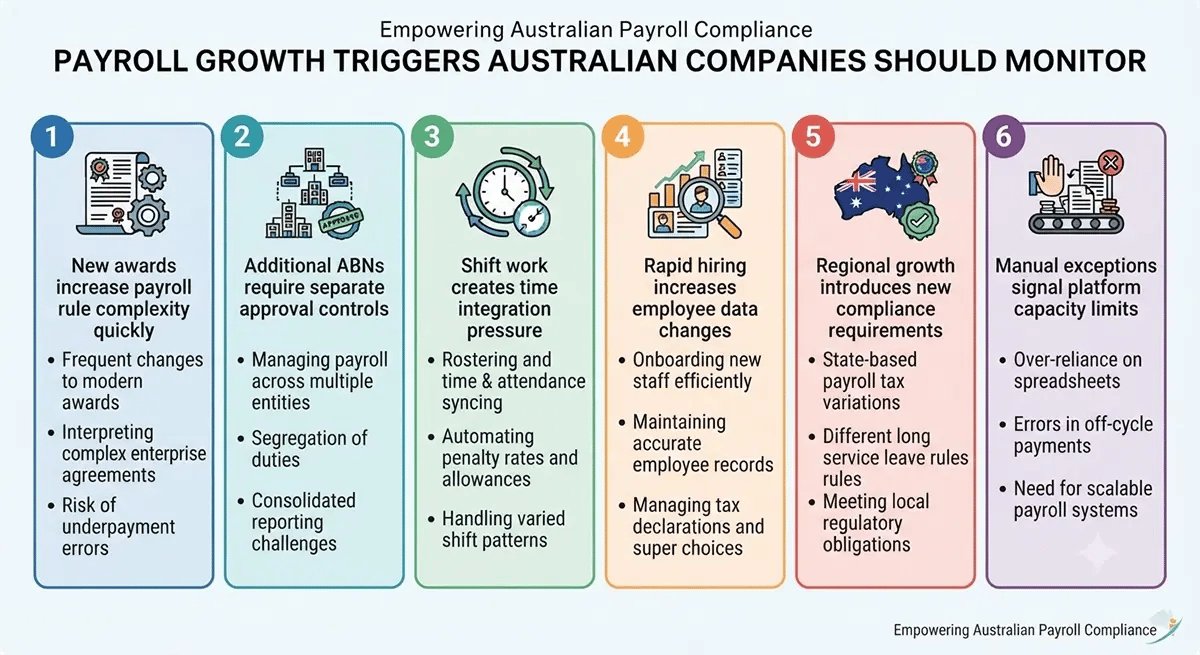
Growing companies outgrow basic systems when new workforce rules exceed the platform’s original scope. Headcount provides only one signal for assessing operational complexity. Awards, ABNs, approvals and integrations can make a smaller workforce harder to pay than a larger salaried team.
The strongest warning signs usually appear across several connected payroll activities.
- New locations introduce different awards, public holidays, payroll tax obligations and local leave rules.
- Additional entities require separate approvals alongside consolidated reporting and governance.
- Shift-based workforces need connected rostering, timesheets, attendance data and reliable award interpretation.
- Rapid hiring increases employee changes and payroll validation requirements each cycle.
- International expansion introduces currencies, country rules, payment rails and additional service relationships.

How Do Manual Payroll Controls Compare With Automated Growth-Ready Compliance?
Automation helps growing companies apply repeatable controls across larger payroll populations. The best payroll system software in Australia should validate information earlier and preserve evidence of reviews. Payroll teams still own employee classifications, source accuracy, approval evidence and final pay decisions.
| Control Area | Manual Payroll Approach | Automated Payroll Approach |
| Employee Changes | Repeated spreadsheet entry | Validated digital workflows |
| Award Rules | Manual rate checking | Configured rule application |
| STP Reporting | Separate file review | Integrated submission process |
| Payday Super | Manual status tracking | Payment and rejection visibility |
| Entity Approvals | Email-based confirmation | Role-based approval routing |
| Audit Evidence | Records rebuilt later | Timestamped actions retained |
Payday Super began on 1 July 2026 and now links super guarantee obligations with each payday. The payroll system software for SMEs below combines payroll, accounting, HR and workforce controls in different ways.
10 Best Payroll System Software in Australia
Here is a quick comparison of the 10 best payroll system software in Australia for growing businesses:
| Payroll Platform | Platform Type | Australian Compliance Functionality |
| Ramco Payce | Enterprise payroll platform with managed service options | ATO-whitelisted STP, PAYG and controlled Australian audit evidence included. |
| Employment Hero Payroll | Connected HR and payroll platform | STP Phase 2, SuperStream, PAYG and Australian workflows included. |
| Xero Payroll | Accounting-connected payroll software | Australian STP, PAYG, superannuation and leave calculations available. |
| MYOB Payroll | Payroll-only and accounting-connected software | Australian tax, superannuation, STP and payroll data processing included. |
| Deputy Payroll | Rostering, time and payroll platform | Approved timesheets feed Australian payroll and award workflows directly. |
| Tanda Payroll | Workforce management and payroll platform | STP Phase 2 combines with Australian award interpretation workflows. |
| CloudPayroll | Focused Australian cloud payroll software | STP Phase 2, Australian payroll and employee self-service available. |
| ELMO Payroll | ANZ-focused HR and payroll platform | Connected Australian payroll includes STP and SuperStream functionality. |
| Ready Workforce | Payroll and workforce management platform | Australian payroll links the interpretation of awards to superannuation workflows. |
| Frontier Software Payroll21 | Regional HR and payroll platform with outsourcing | Australian statutory payroll, STP and outsourced delivery options available. |
Now, it’s time to have a detailed look at these platforms, their features, pros and cons to support informed decision making:
1. Ramco Payce
Ramco Payce supports companies moving from simple payroll towards multi-entity or international operations. The platform combines Australian processing with operator controls, employee access, analytics and managed delivery options. This breadth reduces the risk of having to replace the system again as workforce complexity rises.
Growing companies can introduce additional capabilities as their operating requirements mature. Payroll teams gain greater visibility into runs, while employees receive accessible service channels. Finance leaders can also analyse payroll patterns without rebuilding separate entity reports.
Key Features
- STP-ready Australian payroll processing supports PAYG and detailed reporting requirements.
- Payroll Workspace tracks pay runs, approvals, interfaces and unresolved exceptions.
- BInGO analyses payroll costs, operating trends and material variances clearly.
- Daily HR supports employee self-service across routine payroll and HR tasks.
- Chia provides round-the-clock payroll and HR query support across familiar channels.
- Multi-country payroll and managed services support future regional or international expansion.
Best For
Ramco Payce suits growing mid-market companies expecting to handle several entities, complex workforces, or international expansion. It also supports payroll teams considering flexible managed service delivery options.
Australian Compliance Functionality
We provide ATO-whitelisted Single Touch Payroll capability alongside Australian payroll processing and controlled evidence. Employers retain responsibility for workforce classifications, source information, workplace rules and final approval decisions.
Benefits and Considerations
| Benefits | Considerations |
| Scales into enterprise payroll complexity | Requires structured implementation planning |
| Strong operator exception visibility | More capability than microbusinesses require |
| Software and managed service options | |
| Supports regional and global expansion |
2. Employment Hero Payroll
Employment Hero combines payroll with HR workflows inside a broader employment platform. Growing SMEs can manage onboarding, employee records, leave workflows, and routine payroll from a single environment. Buyers should compare package inclusions as workforce rules and entity requirements expand.
Key Features
- Connected HR and payroll reduce the need for repeated employee information handling across workflows.
- Award interpretation supports selected Australian workforce conditions and applicable pay rates.
- Employee self-service provides access to payslips and leave, as well as personal information.
Best For
Employment Hero suits SMEs seeking accessible HR and payroll workflows on a single, connected Australian employment platform.
Australian Compliance Functionality
The platform supports STP Phase 2, SuperStream, PAYG and Australian payroll. Buyers should carefully confirm award coverage, service scope, support depth, and future entity requirements.
Benefits And Considerations
| Benefits | Considerations |
| Connected HR and payroll | Package inclusions vary |
| Strong SME fit | Complex groups need deeper review |
| Employee self-service | Awards require scenario testing |
3. Xero Payroll
Xero Payroll connects routine payroll with its established accounting platform. Australian small businesses can manage PAYG, superannuation, leave and STP reporting together. The model works best while workforce rules and approval structures remain relatively straightforward.
Key Features
- Automatic PAYG and super calculations support leave and regular payroll processing.
- Xero Me gives employees mobile access to payslips and leave information.
- Accounting integration creates connected payroll journals and clearer financial reporting outputs.
Best For
Xero provides practical payroll software for startups and smaller businesses already using its accounting platform.
Australian Compliance Functionality
Xero supports STP reporting and PAYG, as well as superannuation processing requirements. Growing companies should assess employee limits and complex award requirements before expansion.
Benefits And Considerations
| Benefits | Considerations |
| Strong accounting connection | Suits smaller workforces |
| Familiar user experience | Complex awards need support |
| Mobile employee access | Limited entity governance |
4. MYOB Payroll
MYOB offers payroll-only and accounting-connected options for Australian small businesses. It automates routine tax and super calculations while supporting STP reporting. The familiar financial environment suits companies that want focused payroll without adopting a wider workforce platform.
Key Features
- Automated tax and super calculations support routine payroll processing each cycle.
- STP reporting connects payroll information directly with the ATO each cycle.
- MYOB Team supports timesheets and leave, as well as employee information collection.
Best For
MYOB suits smaller companies seeking familiar accounting workflows, practical payroll, and employee data collection.
Australian Compliance Functionality
MYOB supports STP reporting and Australian tax or superannuation calculations. Buyers should carefully test award depth, approval controls, integrations, and future entity requirements.
Benefits And Considerations
| Benefits | Considerations |
| Familiar financial environment | Awards need careful configuration |
| Payroll-only option | Advanced workflows may need alternatives |
| Employee onboarding support | Multi-entity growth needs review |
5. Deputy Payroll
Deputy Payroll connects approved timesheets with payroll inside its shift-work platform. This design reduces handoffs between rostering and pay processing across hospitality, retail, healthcare and service companies. Buyers need an active Deputy account to use payroll features.
Key Features
- Approved timesheets move directly from rostering into connected payroll processing workflows.
- Award controls support complex shift-based workforce calculation requirements across locations.
- Multi-location tools connect scheduling and attendance with related payroll activities.
- Employee access includes rosters and leave, as well as relevant payroll information.
Best For
Deputy suits growing shift-based companies already using its rostering and time platform across several locations.
Australian Compliance Functionality
Deputy supports Australian payroll processing and related award-management workflows for employers. Buyers should verify which awards are supported and whether Payday Super handles their workforce.
Benefits And Considerations
| Benefits | Considerations |
| Strong shift-data connection | Requires Deputy platform use |
| Multi-location support | Payroll product remains newer |
| Reduces timesheet transfers | Awards still need testing |
6. Tanda Payroll
Tanda combines rostering, timesheets, award interpretation, and payroll for the Australian workforce. Its strength lies in translating worked hours into payable conditions. Growing shift-based companies can keep scheduling and payroll in a single, connected operating environment.
Key Features
- Award interpretation calculates the applicable pay rates based on approved employee working hours.
- Rostering and timesheets connect workforce activity directly with payroll processing.
- STP2-compliant payroll supports detailed Australian reporting and statutory submission requirements.
Best For
Tanda suits hospitality, retail, healthcare and service companies with award-heavy workforces across several sites.
Australian Compliance Functionality
Tanda supports STP2 reporting and Australian award interpretation requirements for employers. Buyers should verify templates, custom rules, pay conditions and enterprise agreement coverage.
Benefits And Considerations
| Benefits | Considerations |
| Strong award connection | Coverage varies by arrangement |
| Useful for shift operations | Custom rules need review |
| Labour costing support | Governance depth needs assessment |
7. CloudPayroll
CloudPayroll provides Australian cloud payroll with STP Phase 2, employee records, integrations and self-service. The focused platform suits employers moving away from desktop or spreadsheet processes. HR integrations can also reduce the need to handle employee information repeatedly across connected workflows.
Key Features
- STP Phase 2 reporting is available in every available payroll subscription plan.
- Employee Kiosk provides payslips and leave information, as well as access to personal information.
- Cloud access supports distributed payroll teams and stronger business continuity arrangements.
- HR integrations synchronise approved employee and employment information automatically across systems.
Best For
CloudPayroll suits employers seeking a focused, cloud-based payroll system with Australian reporting and employee self-service.
Australian Compliance Functionality
CloudPayroll supports STP Phase 2 reporting and Australian payroll processing requirements. Buyers should carefully assess multi-entity controls, reporting depth, service scope, and future international requirements.
Benefits And Considerations
| Benefits | Considerations |
| Focused Australian payroll | International growth may require alternatives |
| Strong self-service | Analytics need closer review |
| Security certifications | Entity governance needs testing |
8. ELMO Payroll
ELMO connects payroll with an ANZ-focused HR and workforce platform. Its broader environment supports organisations replacing separate HR processes with connected employee data. The mid-market focus suits companies that need payroll, rostering, HR, and workforce management capabilities.
Key Features
- Connected HR and payroll reduce the need for repeated workforce information entry across processes.
- Cloud payroll supports Australian calculations and employee processing across pay cycles.
- Reporting regularly supports informed payroll and broader workforce management decisions.
Best For
ELMO suits Australian mid-market organisations seeking connected HR, payroll, rostering and workforce management within one platform.
Australian Compliance Functionality
ELMO supports STP reporting and SuperStream requirements within Australian payroll. Buyers should test award configuration, reporting depth, integration requirements and implementation capacity.
Benefits And Considerations
| Benefits | Considerations |
| Connected ANZ platform | Implementation needs capability |
| Strong mid-market fit | Awards require validation |
| Wider HR functionality | Smaller firms may need less breadth |
9. Ready Workforce
Ready Workforce combines payroll with time, attendance, rostering and workforce management. It supports organisations where pay depends on detailed contracts or shift patterns. Growing employers should consider the implementation effort required for broader workforce change.
Key Features
- Payroll connects directly with approved rostering and employee time information.
- Award interpretation automates complex calculations of employment rules across workforce groups.
- Super fulfilment supports connected payroll and statutory payment workflows each cycle.
- Employee self-service improves secure access to relevant workforce information.
Best For
Ready Workforce suits organisations with complex contracts, shift patterns, or multiple locations that require integrated workforce management.
Australian Compliance Functionality
Ready Workforce supports ATO-focused payroll processing and Australian award interpretation. Buyers should test contract rules, shift loadings, award interpretation and implementation requirements.
Benefits And Considerations
| Benefits | Considerations |
| Strong workforce integration | Wider implementation needs planning |
| Handles complex arrangements | Smaller firms may find excessive breadth |
| Useful for operational sectors | Custom rules need testing |
10. Frontier Software Payroll21
Frontier combines Payroll21 with its ichris HR environment and optional outsourcing. The platform supports Australian payroll alongside processing across several international countries. Growing companies pursuing regional expansion can use a single global HR database while selecting different payroll service levels.
Key Features
- Integrated HR and payroll support one connected workforce data environment.
- Payroll21 provides statutory payroll processing across multiple international country environments.
- Outsourced payroll offers flexible service responsibility and specialist support options.
Best For
Frontier suits companies approaching regional growth or complex payroll operations that need software alongside outsourced delivery choices.
Australian Compliance Functionality
Payroll21 supports Australian statutory payroll processing and integrated HR information management. Buyers should compare implementation needs and resources with lighter SME payroll platforms.
Benefits And Considerations
| Benefits | Considerations |
| Supports regional expansion | Implementation exceeds basic SME needs |
| Flexible outsourced services | Architecture needs technical assessment |
| Global HR database | Smaller teams may prefer lighter tools |

What Should Growing Companies Compare Before Shortlisting Payroll Systems?
Growing companies should compare future complexity alongside present usability and cost. The best payroll system software in Australia should support at least three years of expected changes without overwhelming current teams. Scenario testing gives buyers stronger practical evidence than standard platform demonstrations provide.
| Evaluation Area | Question To Ask |
| Growth Forecast | What will payroll complexity look like in three years? |
| Award Coverage | Can the system handle actual workforce rules? |
| Entity Structure | Can it add ABNs and approval chains? |
| Integration | How are failed records identified and resolved? |
| Super Processing | How are rejected Payday Super transactions handled? |
| Service Model | Which activities remain with internal teams? |
| Exit Readiness | Can records and evidence leave the platform? |
Buyers should test access controls, hosting, subprocessors and incident ownership before choosing a scalable payroll management system.
How Is AI Changing Payroll for Growing Companies?
AI can help growing payroll teams focus attention where risk appears highest. The best payroll system software in Australia should use AI to support investigation and service. Automated recommendations should never control sensitive employee pay decisions without human approval.
PayrollOrg’s 2025 global payroll survey found that 21% of respondents already used AI solutions. A further 30% planned to introduce AI into payroll operations, showing growing interest in compliance monitoring, process automation and predictive payroll insights.
- Anomaly detection can highlight unusual payroll movements before final approval.
- Natural-language reporting can significantly reduce dependence on specialist report builders.
- Query assistants can address routine employee payroll questions across channels.
- Forecasting can help teams anticipate funding and workload pressure earlier.
Ramco’s AI payroll automation connects anomaly review with practical payroll workflows. Human reviewers should retain control over every decision that changes employee pay.
Why Can Ramco Payce Support Companies as Payroll Complexity Increases?
At Ramco Payce, we support companies as they move from one Australian payroll towards multi-entity, high-volume or international delivery. Ramco Payce combines Australian processing with wider governance, allowing teams to add capability as business structures and workforce requirements become more complex.
Operational visibility becomes more important when pay groups and interfaces multiply. Payroll Workspace brings runs, interface errors, approvals, and unresolved exceptions into a single view. This structure helps payroll leaders identify delayed actions before they affect employees or statutory reporting.
BInGO adds conversational analysis across payroll costs and material operating variances. Our payroll outsourcing services in Australia can add capacity during specialist shortages or regional growth.
Compare Ramco Payce with your three-year workforce plans, entity structure, payroll complexity and expected regional growth requirements. Book a free demo today to get started.
You may also like!