TL;DR
Australian payroll software helps businesses manage Modern Awards, PAYG withholding, Single Touch Payroll (STP) Phase 2, Payday Super, payroll tax, leave entitlements and record-keeping obligations. Automated payroll workflows improve calculation consistency, streamline reporting and maintain digital audit trails, helping teams reduce repetitive work and identify compliance issues earlier. From 1 July 2026, Payday Super requires a 12% super guarantee on qualifying earnings, with contributions generally reaching employees’ super funds within seven business days of payday. AI-powered anomaly detection can flag unusual pay movements before approval, but employers remain responsible for accurate employee classifications, payroll configuration and final compliance decisions. Ramco Payce supports Australian payroll compliance through award interpretation, STP reporting, Payroll Workspace, analytics and employee self-service.
Introduction:
Australian payroll software now sits inside a tighter compliance environment than many employers faced only a few years ago. During 2024–25, the Fair Work Ombudsman recovered $358 million for more than 249,000 underpaid workers. Large corporate employers accounted for about 60% of those recoveries.
That enforcement picture now meets faster pay-cycle obligations through Single Touch Payroll and Payday Super. Payroll teams must calculate correctly and report accurately, while leaders need clear evidence across every pay event and exception.
Australian payroll software supports that control chain by connecting workforce data with calculation, reporting, review and evidence. Employers still own classification decisions and payroll governance, so technology works best when teams combine automation with clear accountability.
For a wider regulatory view, refer to our Australian Payroll Compliance Checklist 2026.
| Key Takeaways: |
- Compliance automation: Australian payroll software connects Modern Award calculations, PAYG withholding, STP reporting, superannuation workflows and digital records to reduce repetitive work and improve payroll traceability.
- Modern Award accuracy: Payroll software applies configured rates, overtime, penalties and entitlements, but employers must verify award coverage, employee classifications and effective dates.
- STP and Payday Super: From 1 July 2026, employers must calculate super guarantee at 12% of qualifying earnings and generally ensure contributions reach employees' funds within seven business days of payday.
- Human oversight and AI: Payroll automation and AI-powered anomaly detection help identify unusual pay movements and preserve audit evidence, while employers retain responsibility for payroll configuration, exception resolution and compliance decisions.
|
Why Is Payroll Compliance Difficult to Manage Manually in Australia?
Australian payroll combines workplace rules and tax reporting with superannuation and state-based obligations across every pay cycle. Fair Work currently lists 121 modern awards, which define minimum conditions across industries and occupations. Each award can shape wages, overtime, penalty rates and hours, creating significant rule complexity.
Manual processes become harder to control when employee circumstances change during a pay cycle. A classification update or roster change can alter pay treatment across one employee group. Separate spreadsheets also make those changes harder to trace across approvals and later compliance reviews.
Australian payroll software provides teams with a structured way to apply configured rules to recurring payroll events. This structure strengthens payroll compliance in Australia when teams maintain accurate source data and clear ownership. A payroll management system in Australia can retain evidence of calculations alongside approval histories.

Which Australian Payroll Compliance Duties Can Software Automate?
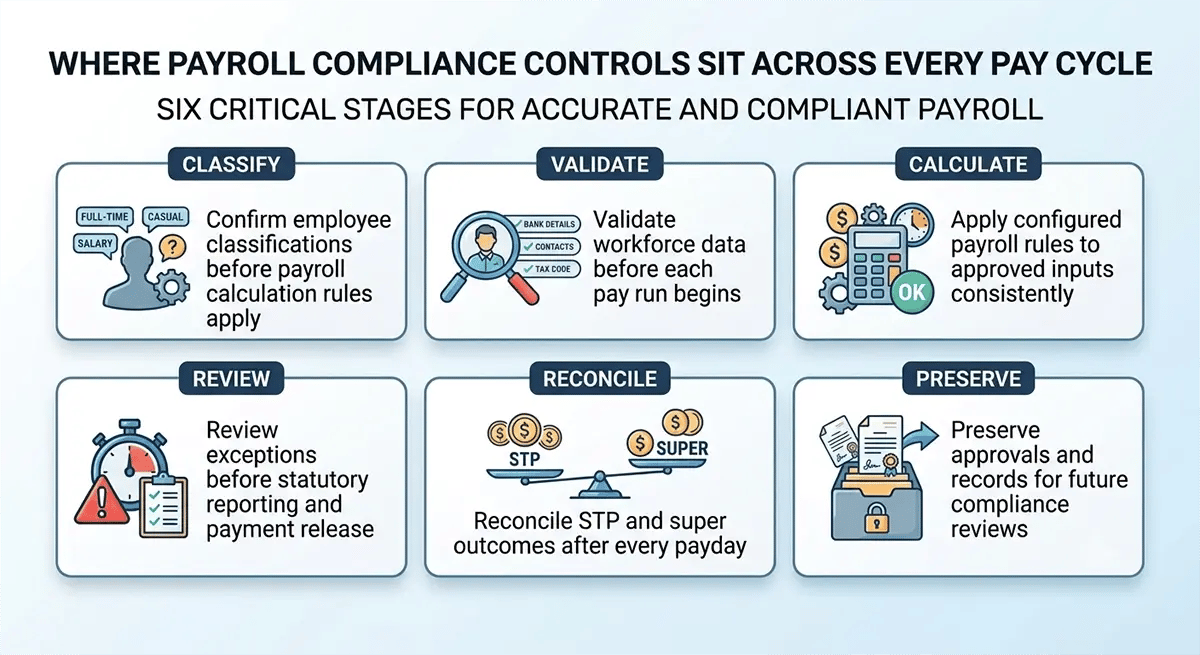
Australian payroll software can automate calculation, validation, reporting and record-keeping tasks across each pay cycle. Employers still need accurate employee data and correct classifications, while payroll leaders must maintain governance around exceptions and final approvals.
These seven compliance areas show where automation can strengthen control while maintaining clear human accountability.
| Compliance Area |
What Payroll Software Can Support |
Human Control Still Required |
| Modern Awards and agreements |
Ramco Payce can apply configured rates, penalties, allowances and entitlements using approved employee and time data. |
Payroll teams confirm award coverage and employee classification before they apply relevant agreement rules. |
| STP Phase 2 |
STP-enabled workflows can map pay components and prepare required pay-event information for ATO reporting. |
Reviewers resolve rejected events and mapping issues before they approve required corrections. |
| Payday Super |
Payroll systems can calculate qualifying earnings and support contribution workflows for every relevant payday. |
Teams investigate failed contributions and incorrect fund details before compliance windows close. |
| PAYG withholding |
Software can apply current tax tables and calculate withholding from approved employee settings. |
Payroll specialists maintain declarations and review unusual withholding results before release. |
| Payroll tax |
Ramco Payce can support state-based payroll tax calculations and configured reporting workflows. |
Finance teams review grouping arrangements and exemptions alongside jurisdiction-specific tax treatment. |
| Leave and entitlements |
Configured payroll rules can calculate applicable leave accruals and maintain current employee balances. |
HR and payroll teams review eligibility when employee circumstances affect entitlement treatment. |
| Records and audit evidence |
Digital workflows can retain payroll data, payslips, approvals and change histories for later review. |
Employers maintain accurate records and ensure authorised users can retrieve required evidence. |
Ramco's Australian payroll proposition includes award interpretation, STP Phase 2, payroll tax and superannuation capabilities within Payce. Automation works best when teams define clear ownership around classifications and source data, with documented exception responsibilities. This foundation supports automated payroll processing in Australia without weakening specialist review.
How Does Automated Payroll Compare With Manual Compliance Processes?
Automated payroll establishes a repeatable control path for recurring compliance activities, whereas manual methods rely more heavily on separate checks. The greatest advantage comes from consistent execution across pay cycles, especially as employee volumes and regulatory changes increase.
The comparison below shows how Australian payroll software can reduce repetitive work while keeping specialist payroll judgment within the process.
| Compliance Process |
Manual Payroll Approach |
Automated Payroll Software |
| Award calculations |
Teams review classifications and time records before calculating changing rates manually. |
Configured rules apply approved rates and entitlements from validated payroll inputs. |
| STP reporting |
Teams may re-enter payroll data through a separate STP-enabled reporting process. |
Integrated workflows prepare pay-event information and support direct STP reporting processes. |
| Payday Super |
Teams calculate contributions and track payment outcomes through separate manual checks. |
Connected workflows link super calculations with payment status and contribution exceptions. |
| Payroll tax |
Teams manually monitor thresholds and calculations across different state revenue requirements. |
Configured rules can support state-based calculations using approved wage information. |
| Audit evidence |
Supporting records may remain across spreadsheets, emails, shared drives and separate payroll files. |
Digital workflows create clearer transaction histories and evidence of approvals for later reviews. |
Automation improves consistency across recurring tasks, while payroll expertise remains essential for classification decisions and unusual employee circumstances. Strong governance keeps automated controls aligned with employment obligations across every pay cycle.
How Can Payroll Software Reduce Modern Award Compliance Risk?
Modern Award compliance starts with correct coverage and employee classification before any calculation occurs. Australian payroll software then applies configured rules to approved time and employee data. The Fair Work Commission can vary award provisions, so payroll teams must carefully manage effective dates and configuration changes.
Configured rules can calculate overtime, penalty rates, allowances and other applicable entitlements from approved inputs. A weekend shift may trigger different conditions after worked hours cross an overtime threshold. Accurate time data therefore shapes the final payroll result for every affected employee.
Ramco Payce supports automated award interpretation alongside enterprise agreement rules for Australian payroll operations. Payroll leaders still need review controls for annualised salaries and classification changes. Unusual work patterns also require specialist judgement before teams approve the final payroll outcome.
How Can Payroll Software Keep STP and Payday Super on Track Every Pay Cycle?
Australian payroll software can integrate STP reporting and Payday Super into a single pay-cycle control environment. This approach helps teams validate payroll inputs earlier and track super obligations. It also gives teams more time to address rejected transactions before correction windows tighten.
The strongest workflow connects reporting with payment status and links both areas to reconciliation after every completed pay event in live production.
- STP-enabled software should map pay components correctly before teams submit payroll information to the ATO each pay cycle.
- From 1 July 2026, employers calculate super guarantee at 12% of qualifying earnings for each relevant payday.
- Employee funds must receive contributions within seven business days after payday, unless an approved extended timeframe applies.
- Payroll teams need visibility into rejected contributions because delayed corrections reduce the remaining compliance window considerably.
- Updated STP reporting also carries qualifying earnings and super-liability information through each applicable payroll reporting process.
- Reconciliation should connect payroll liability with payment status, fund receipt and unresolved contribution exceptions after each payday.
The ATO confirms the 12% qualifying earnings calculation and the 7-business-day receipt requirement under Payday Super.
Ramco's Single Touch Payroll software supports Australian STP reporting and pre-submission validation. Payroll leaders can also use the Payday Super Readiness Guide for implementation guidance.

What Other Payroll Rules Should Australian Software Help Teams Manage?
Modern payroll systems should support obligations that extend well past STP and superannuation. Payroll teams also manage PAYG withholding, state payroll tax, leave obligations, Paid Parental Leave and record-keeping duties across different employee circumstances.
Five areas warrant structured attention within the broader payroll compliance model.
- PAYG Withholding: Payroll teams need current tax tables and accurate employee tax settings for each applicable pay cycle. Software can calculate withholding based on approved inputs, while payroll specialists still investigate any unusual results before final payroll approval.
- State Payroll Tax: State and territory revenue offices set different payroll tax thresholds and rates across Australia, while exemptions also vary. Software can support configured calculations and wage categorisation, while finance teams still review grouping rules and jurisdiction-specific tax treatment.
- Leave Entitlements: Payroll processes need accurate leave balances and entitlement rules for each covered employee. Teams should distinguish National Employment Standards entitlements from long-service leave requirements, because state or territory rules may affect those calculations.
- Paid Parental Leave: Families with children born or adopted from 1 July 2026 can access up to 26 weeks. Payroll systems may support employer-administered payments and related records where Services Australia requires employer participation.
- Payroll Records: Fair Work requires employers to keep relevant time and wage records for seven years. Digital payroll records can improve traceability and retrieval, while payroll teams must preserve accuracy and access throughout the retention period.
What Can Payroll Non-Compliance Cost an Australian Employer?
Payroll non-compliance can create back-pay liabilities, civil penalties, investigation costs and criminal exposure for intentional underpayment. Leaders can also face investigation costs and operational disruption when payroll controls fail. Early detection helps teams correct errors before problems spread across repeated pay cycles.
The current Fair Work framework shows why payroll governance now carries direct financial consequences.
| Exposure |
Current Compliance Context |
What Leaders Should Understand |
| Civil underpayment contravention |
Larger employers can face the greater of $546,000 or three times the underpayment for each contravention. |
Repeated payroll errors can create material financial exposure across affected pay cycles. |
| Serious contravention |
A company with at least 15 employees can face up to $5.46 million for some serious contraventions. |
Knowing or reckless breaches can create far greater exposure than isolated payroll mistakes. |
| Intentional criminal underpayment |
Companies can face the higher of $9.1 million or three times the underpayment when courts determine the amount. |
Individuals can also face substantial fines or imprisonment for intentional underpayment offences. |
| Record-keeping failures |
Fair Work can pursue civil remedies when employers breach relevant record-keeping obligations. |
Reliable payroll evidence supports review and reduces uncertainty during regulatory enquiries. |
Fair Work's current September 2026 guidance confirms the civil penalty figures and a $9.1 million criminal company penalty. Individuals can also face up to 10 years' imprisonment for intentional underpayment offences.
These figures show why payroll leaders need prevention controls rather than retrospective correction alone. Accurate calculations and reliable records give employers a stronger foundation for compliance.
Where Can AI Strengthen Payroll Compliance Without Removing Human Review?
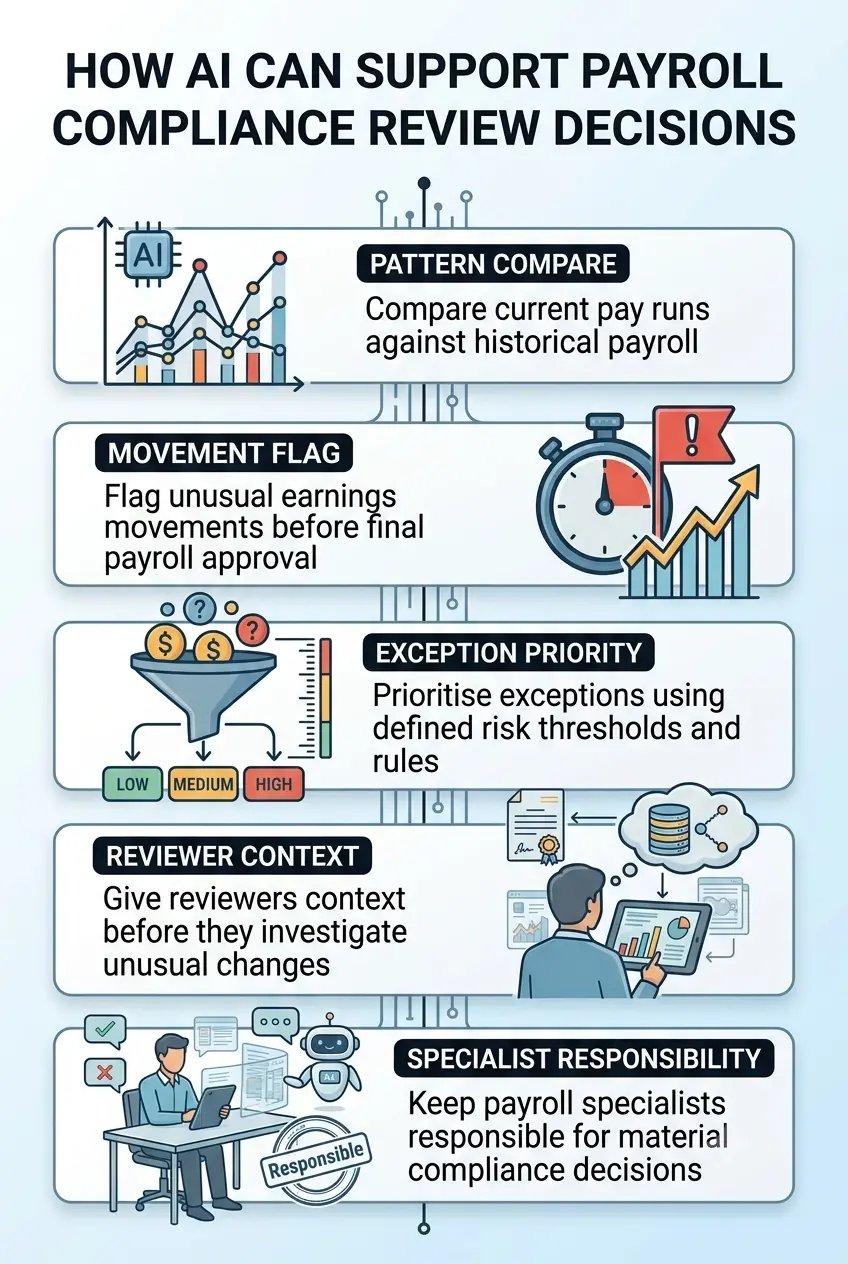
AI can strengthen payroll compliance by identifying unusual activity and directing reviewers to higher-risk exceptions. Payroll specialists should still approve material corrections and rule changes affecting employee outcomes.
Gartner reported that 59% of surveyed finance leaders used AI during 2025. Among AI users, 34% applied it to error and anomaly detection.
Four use cases show where AI can support payroll specialists while preserving clear review authority.
- Anomaly Detection: AI can compare current pay runs against historical patterns and flag unusual changes before approval. Payroll Workspace helps operators review those anomalies before teams release payroll.
- Exception Prioritisation: AI can direct attention towards exceptions carrying greater financial or compliance impact. Reviewers can then investigate unusual earnings movements instead of checking every payroll record equally.
- Compliance Monitoring: Automated checks can compare configured rules with incoming payroll data and highlight mismatches. Payroll specialists still assess unusual employee circumstances before approving material corrections.
- Human Review: Payroll leaders should retain authority over significant corrections and rule changes affecting employee outcomes. BInGO can provide additional payroll context before leaders decide how teams should respond.
Conclusion: How Can Ramco Payce Support Payroll Compliance in Australia?
At Ramco, we designed Payce to connect payroll processing and analysis with employee support and operational visibility. Our cloud payroll software in Australia provides teams with a single environment for managing complex pay-cycle controls.
Several Payce capabilities can strengthen this operating model across complex Australian payroll environments.
- Our platform supports Modern Awards and enterprise agreements through configured payroll rules aligned with approved workforce data.
- Our STP capabilities support ATO-aligned reporting with validation before teams move payroll information through each reporting process.
- Payroll Workspace brings pay-run activity, anomalies, integration issues and reports into one view for payroll operators.
- BInGO gives payroll leaders on-demand reporting and analytical insight without repeated manual extraction from separate spreadsheets.
- Daily HR supports employee access to payslips and leave information, while CHIA handles many routine payroll queries.
This combination helps payroll teams integrate routine processing, exception management, and employee access into a single operating model.
Ramco also offers managed payroll services when internal capacity or operating complexity creates additional delivery pressure.
Strengthen payroll controls with Ramco Payce and give your teams clearer visibility across every Australian pay cycle. Book a free demo today to get started.


 How does Australian payroll software help businesses stay compliant?