What Changes With Payday Super From 1 July 2026?
Published :

Australian payroll compliance software is evolving from a payroll processing tool into a broader compliance control system. The key trends leaders should track are Payday Super from 1 July 2026, STP Phase 2, AI-powered anomaly detection, payroll tax visibility, data security, connected HR and finance systems, and audit-ready evidence. The right software helps teams identify compliance issues earlier, manage exceptions, and maintain clear records while keeping human oversight over important payroll decisions.
Australian payroll compliance now extends to finance, HR, legal, and board-level risk discussions. ABS data shows Australian employers paid $103.9 billion in wages and salaries in June 2025, up 5.9% from June 2024. This payroll volume explains why Australian payroll compliance software is becoming a leadership priority.
The pressure will increase as payroll timelines tighten. Payday Super starts on 1 July 2026 and requires super contributions to reach employee funds within 7 business days after payday. Australian payroll compliance software must therefore help teams see issues before payments or reports leave payroll.
This guide explains the software trends that Australian leaders should track. It covers STP, Fair Work records, payroll tax, AI, data security, connected systems and audit evidence. It also shows where Ramco Payce can support compliance visibility and daily payroll control.
Australian payroll compliance software helps employers calculate obligations, apply rules, report to authorities and retain evidence across pay cycles. It supports STP, PAYG, super, payroll tax, Fair Work records and exception handling. Employers still own data accuracy, approvals and final payroll decisions.
A growing business should assess Australian payroll compliance software through the obligations it helps control. Each capability should connect payroll processing with evidence that leaders can review.
The practical value sits in the connection between calculation and evidence. The payroll compliance solution should help teams explain what changed, who approved it and what still needs attention.

Manual payroll compliance depends on spreadsheets, calendar reminders and reviewer capacity. Australian payroll compliance software can manage rules, alerts, approvals, and records within each payroll cycle. Strong automated payroll compliance in Australia improves control when leaders keep human approval over material decisions.
| Compliance Area | Manual Payroll Compliance | Automated Payroll Compliance |
|---|---|---|
| STP Reporting | Teams validate fields after calculation. | The system flags missing data before lodgement. |
| Award Checks | Specialists compare rules through spreadsheets. | Configured rules apply approved logic consistently. |
| Super Payments | Teams track rejected contributions manually. | Alerts show failed records and ownership. |
| Payroll Tax | Finance consolidates wages by jurisdiction. | Reports show state-level exposure earlier. |
| Audit Evidence | Evidence sits across separate files. | Records connect calculations, approvals and corrections. |
Automation helps when it shifts review earlier in the process. Payroll leaders should still define who approves exceptions, corrections and statutory submissions.
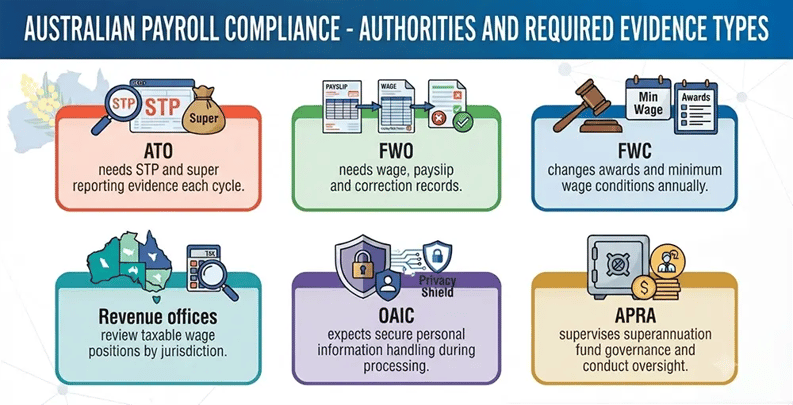
Australian payroll compliance software should support the authorities that shape payroll obligations. The system should help teams prepare evidence for the ATO, the Fair Work Ombudsman, the Fair Work Commission, state revenue offices, the OAIC, and super-related oversight. Each authority affects a different payroll control point.
These authorities create different evidence requirements within a single payroll operation. Australian payroll compliance software should help teams avoid fragmented records across emails, extracts and local files.
Payday Super will turn super from a periodic finance task into a pay-cycle compliance control. The payroll compliance software must help teams validate super data, detect rejected records and reconcile payment evidence faster. This makes cloud payroll compliance in Australia a daily operating concern.
Before Payday Super begins, leaders should review where super data is entered into payroll and where exceptions occur.
Ramco’s Payday Super payroll risks guide explains the operational risks that can appear when super moves into every pay cycle. It can help leaders review failed transactions, cut-off pressure and governance readiness.
AI is changing payroll review by moving attention from broad checking to exception-based action.
McKinsey’s 2025 survey found that 88% of users were already employing AI in at least one business function. Payroll leaders now need to apply AI with strong governance.
Australian payroll compliance software can use AI to flag unusual net pay, duplicate allowances, missed deductions and repeated corrections. These alerts help teams review higher-risk records before approval. Human reviewers still confirm the reason, approve corrections and record the outcome.
Ramco Payce supports this shift through Payroll Workspace and BInGO.
Payroll Workspace provides operators with activity views, anomaly review, task tracking, and reports, while BInGO supports payroll analytics and reporting. This makes Australian payroll regulations software more useful for daily review.
Payroll tax often receives less attention than STP or Fair Work compliance. The payroll compliance solution should help finance teams review wage data by jurisdiction, entity, employment arrangement and taxable category. This becomes crucial as businesses add states, entities and remote employees.
Payroll tax compliance becomes harder when payroll and finance hold different views of the same workforce cost. Australian payroll compliance software should create a common view earlier in the cycle.
Payroll compliance depends on sensitive employee information, including TFNs, bank details, salary records, leave data and identity information. Australian payroll compliance software should protect this data through hosting controls, access governance, encryption and audit logs.
A cloud payroll system in Australia should make these controls visible during procurement and audit review. Ramco’s cross-border payroll data privacy guide provides additional context for ANZ payroll data flows and privacy risk.

Australian payroll compliance software depends on upstream data from HR, time, rostering, leave, finance and banking systems. If that data reaches payroll late or incomplete, compliance checks lose value. Connected data helps teams detect issues before pay, reporting or payment deadlines.
Connected systems give Australian payroll compliance software the data foundation it needs. This is why payroll compliance software in Australia should sit within a wider HR, finance and employee-service view.
Audit evidence requires a dedicated workflow because payroll decisions span multiple sources. Australian payroll compliance software should record calculations, approvals, corrections, employee changes, payment files and submission outcomes together. This helps teams explain payroll decisions after a dispute, review or regulator enquiry.
A practical evidence workflow should answer five questions before payroll closes.
A dedicated evidence workflow reduces end-of-period pressure. It also gives leaders better confidence when they approve payroll, STP, super and payroll tax outputs.
Leaders should evaluate Australian payroll compliance software trends by linking each trend to an operating outcome. AI, cloud hosting, automation and self-service should improve compliance evidence, exception control and employee support. Feature lists carry limited value without business ownership.
| Evaluation Area | What Leaders Should Check |
|---|---|
| Compliance Depth | STP, PAYG, super, awards and payroll tax support. |
| Exception Visibility | Dashboards for unresolved risks before payroll closes. |
| AI Governance | Explainable alerts and human approval workflows. |
| Data Security | Hosting, encryption, access controls and audit logs. |
| Integration Fit | HR, time, finance, banking and reporting connections. |
| Employee Experience | Payslip access, query handling and support tracking. |
Payroll compliance software should help leaders answer what has changed, what needs action, and who owns the next step. Trends should guide better buying questions, rather than create a disconnected feature checklist.
Ramco Payce helps Australian organisations connect payroll processing, STP support, exception review, reporting and employee service. Australian payroll compliance software works best when teams can see data, tasks and evidence before each pay cycle closes.
When STP reporting needs structure, Ramco Single Touch Payroll Software supports ATO-whitelisted STP compliance, PAYG withholding and superannuation workflows. Payroll Workspace then helps operators review anomalies, tasks, and reports within a single payroll work view.
BInGO helps leaders analyse payroll results and exceptions, while Daily HR and Chia support employee access and routine query handling. Together, these capabilities help teams use Australian payroll compliance software as a control system, rather than a reporting tool alone.
Book a Ramco Payce consultation to review cloud compliance readiness.
From 1 July 2026, Payday Super requires employers to pay Superannuation Guarantee contributions on payday, with contributions required to reach employees’ super funds within seven business days. Payroll software should support faster super validation, contribution processing, failed-payment visibility and reconciliation so payroll and finance teams can resolve exceptions promptly.
Australian payroll compliance software supports STP Phase 2 by preparing and validating pay-event data before it is reported to the Australian Taxation Office (ATO). It should support income types, PAYG withholding, superannuation information and relevant tax treatment codes while helping payroll teams identify incomplete employee data and maintain correction records.
No, payroll compliance software does not guarantee Fair Work compliance; it supports employers through configured rules, records, approvals and exception management. Employers remain responsible for employee classifications, award interpretation, pay-rule configuration and payroll governance. Regular reviews of system configuration and correction workflows help identify potential compliance issues earlier.
Australian payroll compliance software should retain payslips, wage records, payroll calculations, employee changes, approvals, corrections, superannuation evidence and relevant audit logs. A connected audit trail should show what changed, who approved it and how corrections were handled, helping employers respond to employee queries, audits and regulator enquiries.
Australian payroll software should help finance teams analyse taxable wages by state or territory, entity and wage category. It should provide jurisdiction-level reporting, grouping visibility and reconciliation against payroll totals. Employers remain responsible for confirming applicable thresholds, taxable amounts, grouping arrangements and lodgement requirements under the relevant state or territory rules.
Australian businesses should look for STP and PAYG support, superannuation controls, Fair Work record management, payroll tax reporting, exception monitoring, audit trails, security controls and integrations. The software should connect these capabilities to the payroll cycle so teams can identify data problems, unresolved exceptions and approval requirements before payroll and statutory outputs are finalised.
Yes, AI can help detect potential payroll compliance issues before approval by identifying unusual pay values, duplicate allowances, missed deductions, recurring corrections and other anomalies. AI should direct payroll specialists toward higher-risk records rather than replace human approval. Material corrections should be reviewed, approved and documented before payroll, STP or superannuation outcomes change.
Cloud payroll software can improve audit readiness by connecting payroll calculations, employee changes, approvals, corrections, payment files and reporting evidence in one workflow. This helps payroll and finance teams establish what changed, which rule applied, who approved the result and what issues remained open when a payroll cycle was completed.
Data security is critical because payroll systems contain sensitive employee information such as identity, banking, salary and tax data. Businesses should assess access controls, encryption, audit logs, secure integrations, data handling, backups and incident-response processes when selecting cloud payroll software.
Yes, payroll compliance software can integrate with HR, time and attendance, rostering, leave, finance, banking and employee-service systems. Connected data helps payroll teams validate employee details, approved hours, leave, classifications and financial outputs before deadlines, while improving consistency across payroll, compliance reporting and finance reconciliation.