1. What Are the Benefits of a Cloud Payroll Management System in Australia?

Published :

Key Takeaways (TL;DR)
Australia had 2,729,648 actively trading businesses at 30 June 2025, including 994,178 employing businesses. As these organisations grow, payroll becomes harder to manage across expanding workforces, new locations, more pay groups and changing compliance obligations. The payroll management system must keep pace with that added complexity.
Older platforms often rely on local installations, manual transfers, spreadsheet checks and separate reporting tools. These limits slow approvals and hide problems until the pay run reaches its final stages. Cloud payroll gives leaders a more connected way to manage operations across teams and locations.
This guide explains five reasons to choose cloud payroll software in Australia. It covers automation, compliance, visibility, scalability, security and employee access. It also helps leaders decide whether their current payroll management system can support future growth.
Cloud payroll software hosts payroll applications and data within a secure online environment. Authorised teams access the payroll management system through approved devices and controlled user permissions. The platform can connect calculations, approvals, reporting, and employee services within a single operating model.
A suitable online payroll system in Australia should also support STP, PAYG withholding, super and Fair Work record requirements.
Manual payroll compliance depends on spreadsheets, calendars, reminders and reviewer capacity. Automated compliance places configured rules, validations, approvals and evidence inside each payroll cycle. Employers retain legal accountability, although stronger controls can help teams identify issues before payment or statutory reporting deadlines.
| Compliance Area | Manual Payroll | Automated Payroll Compliance |
|---|---|---|
| STP Reporting | Teams prepare files and investigate differences after payroll calculations finish. | The system validates pay-event data before STP submission. |
| Award Rules | Specialists compare rates and allowances across separate reference files. | Configured rules apply approved logic across eligible employees. |
| Super Obligations | Teams track liabilities, payment dates and rejected contributions manually. | The system connects super calculations with payment and exception workflows. |
| Record Keeping | Evidence sits across emails, folders and separate reports. | Approvals, amendments and payment records remain linked to each cycle. |
| Exception Review | Reviewers search for problems through samples and spreadsheets. | Automated checks highlight unusual movements before final approval. |
For example, an employer with 1,500 employees across several modern awards may only manually review the largest movements. Automated rules can flag unusual changes to overtime, allowances, penalty rates, and classifications before employees receive payment.
A cloud payroll management system reduces manual work by connecting payroll inputs, calculations, approvals and reports through repeatable workflows. Teams spend less time rebuilding files or chasing routine actions. They can focus on exceptions that may affect employees, payments, reporting or compliance outcomes.
Ramco Payroll Workspace supports this approach through activity views, anomaly review, task tracking and report access. It helps operators see what needs attention before payroll moves towards approval. Faster processing creates the most value when the payroll management system also strengthens compliance controls.
Cloud payroll can support Australian compliance by applying configured rules, creating STP records, and retaining evidence of calculations. A payroll management system also helps teams respond faster when tax or super requirements change. Employers still own configuration, governance, review and final payroll accuracy.
A fortnightly employer may discover a rejected super payment several days after payday. The payroll management system should identify that rejection, assign ownership and preserve evidence before the correction window closes.
Also Read: Australian Payroll Compliance Checklist
A cloud payroll management system provides authorised teams with a real-time view of payroll status, costs, liabilities, and exceptions. Leaders can identify unresolved issues before final approval and assign owners earlier. This supports quicker decisions across payroll, HR, finance and compliance functions.
AI can compare current payroll results with historical patterns and relevant employee groups. It can flag unusual allowances, missed deductions, duplicate payments or sharp net-pay movements for review. Automation can also identify failed integrations, late inputs, missing approvals and incomplete employee records before payroll closes.
AI should support professional judgement rather than replace it. Payroll specialists must confirm each material exception, approve corrections, record supporting evidence and document the final decision.
Our AI payroll automation guide explains how predictive checks can support earlier error detection and more responsive payroll operations.
A cloud payroll management system supports growth by handling higher volumes, new entities, additional pay groups and changing workforce structures. It can also connect new business systems without rebuilding every payroll process. Leaders gain a more consistent operating model as organisational complexity increases.
Workforce growth adds employees, worker categories, pay groups and payroll calendars. A scalable platform should absorb that volume without requiring an equal increase in spreadsheet checks or manual reconciliation. Entity expansion adds legal employers, funding arrangements, approval routes and reporting requirements.
The payroll management system should maintain central governance while allowing each entity to follow relevant local rules. Integration also becomes more important as the business grows. Payroll should connect with HCM, rostering, time capture, finance and ERP platforms through supported integrations or secure APIs.
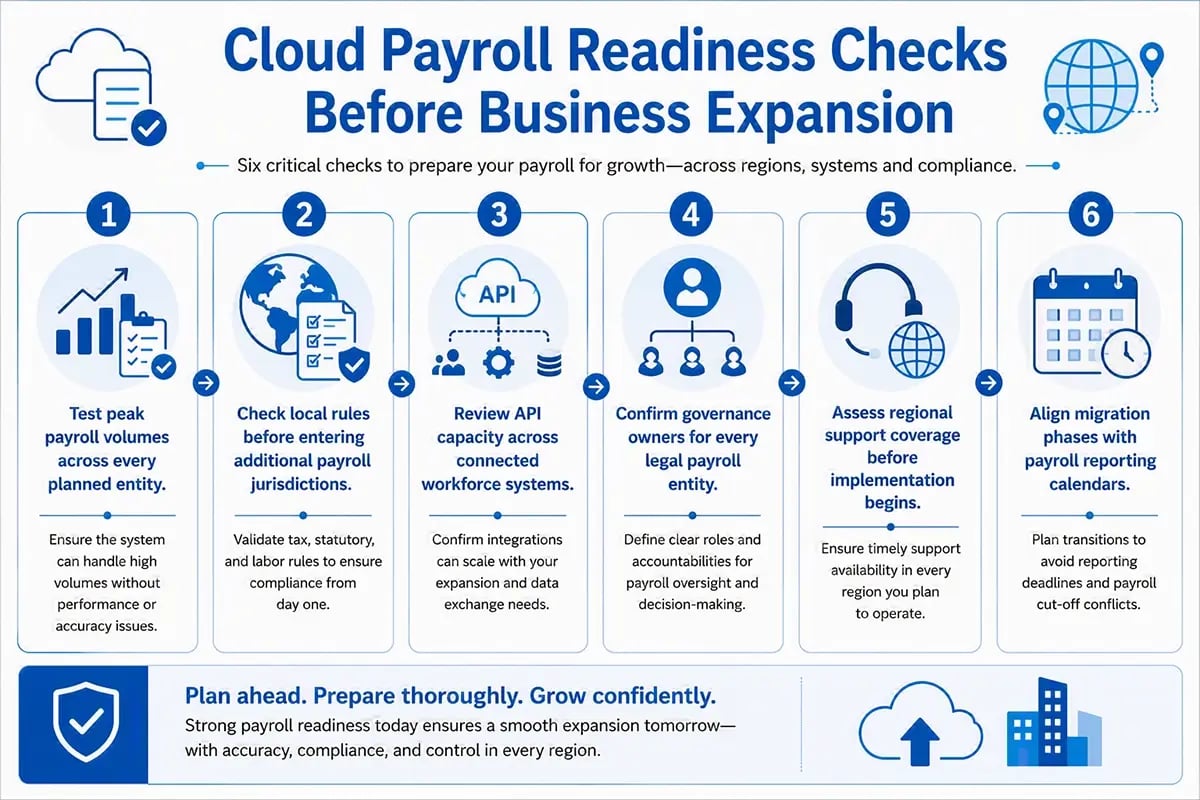
Australian organisations entering new markets need common controls alongside local payroll requirements. Leaders should test processing capacity, country coverage, integration depth and support arrangements before selecting a platform. Organisations considering external support can compare technology ownership with managed payroll services.
Cloud payroll can strengthen data protection and employee access when providers apply suitable security controls. A payroll management system should use role-based access control, encryption, authentication, and audit logs. Employee self-service should also provide secure access to approved payroll information.
Cloud deployment does not remove cyber risk. Provider controls, customer configuration, access governance and response planning still shape payroll security. Australian data residency may support procurement or internal risk requirements, although it does not replace Privacy Act obligations.
Leaders should compare cloud payroll platforms against local compliance requirements, integration depth, security controls, scalability, and employee experience. They should test each capability against realistic payroll scenarios. The selected payroll management system should support current operations and future complexity.
| Evaluation Area | What Leaders Should Assess |
|---|---|
| Australian Compliance | Review STP, PAYG, super, modern awards and Fair Work records. |
| Integration Depth | Confirm connections with HR, time, finance and banking platforms. |
| Security Controls | Review permissions, encryption, authentication, backups and incident response. |
| Scale Fit | Test employee volumes, entities, pay groups and country coverage. |
| Employee Experience | Review payslip access, mobile usability, query support and personal data updates. |
| AI Governance | Confirm that teams can review alerts and supporting evidence. |
| Service Model | Compare software-led and managed payroll operating options. |
Small business payroll software in Australia may prioritise quick setup. Enterprise buyers usually need deeper compliance controls, broader integrations and proven processing capacity.
Ramco Payce is a cloud payroll operating model that connects payroll processing, compliance visibility, analytics, and employee access on a single platform. Our payroll management system operates in more than 150 countries and serves over 500 enterprise customers worldwide. Every year, the platform processes 36 million payslips for large Australian and multi-entity enterprise workforces.
Payroll Workspace pulls activities, anomalies, tasks and reports into a single operating view for payroll teams. BInGO layers real-time reports and exception insights over that operational data for finance and HR leaders.
Daily HR gives employees direct access to payroll and leave information across every workday of the year. Chia handles routine payroll questions through conversational channels without opening a support ticket each time.
Together, these capabilities connect payroll operations with compliance visibility, employee access, leadership reporting and Australian workforce scale. Book a Ramco Payce consultation to assess payroll compliance, cloud readiness, integration priorities and future workforce requirements.
A cloud payroll management system helps Australian businesses automate payroll processes, improve compliance visibility, reduce manual work, and support workforce growth. It connects payroll calculations, approvals, reporting, employee services, and compliance controls through a single platform. For growing organisations, cloud payroll provides a more scalable way to manage increasing employees, entities, pay groups, and changing payroll requirements.
Businesses move from traditional payroll software to cloud payroll when legacy systems create operational limitations. Cloud platforms reduce dependence on local infrastructure, simplify system updates, improve accessibility, and support better collaboration across payroll, HR, finance, and leadership teams. They also help organisations respond faster to changing compliance requirements, integrations, and workforce complexity.
Cloud payroll supports growing businesses by providing the flexibility to manage more employees, locations, entities, and pay structures without increasing manual administration. A scalable payroll system can support new workforce models, connect with HR and finance platforms, and maintain consistent payroll controls as business requirements change.
Cloud payroll improves automation by connecting employee data, payroll calculations, approvals, reporting, and compliance checks within a controlled workflow. It reduces repetitive tasks such as manual data entry, spreadsheet reconciliation, and approval tracking. Payroll teams can spend more time reviewing exceptions and improving payroll accuracy instead of managing routine administration.
Businesses should evaluate cloud payroll systems based on Australian compliance capability, scalability, integration options, security controls, reporting visibility, employee experience, and implementation support. The right platform should support requirements such as STP Phase 2 reporting, superannuation processing, award interpretation, audit records, and future business growth.
Cloud payroll software can provide strong security when supported by appropriate controls such as encryption, role-based access, authentication, monitoring, backups, and audit logging. Businesses should review the provider’s security framework, data protection practices, access governance, and incident response processes before selecting a cloud payroll platform.
A cloud payroll management system can support STP Phase 2 and Payday Super requirements by automating payroll calculations, maintaining reporting data, and connecting compliance activities with payroll workflows. Employers must still validate employee information, review payroll results, manage exceptions, and ensure superannuation obligations are completed accurately and on time.
Cloud payroll software can help businesses support Fair Work compliance by applying configured award rules, maintaining payroll records, tracking approvals, and identifying unusual payroll changes. However, technology alone cannot guarantee compliance. Employers remain responsible for accurate employee classifications, correct rule configuration, payroll reviews, and effective governance processes.
Australian employers must keep accurate time and wage records for seven years. These records should remain legible, be written in English, and be accessible to Fair Work Inspectors when required. Businesses should also retain payslips, pay rates, deductions, leave records, payroll approvals, superannuation evidence, and correction histories to support compliance reviews.
Cloud payroll data does not always need to be hosted in Australia under Australian privacy laws. However, businesses must consider privacy obligations, contractual requirements, internal policies, and customer expectations when selecting a cloud payroll provider. Organisations should understand where data is stored, how it is protected, and who can access sensitive payroll information.
The time required to migrate to cloud payroll depends on workforce size, payroll complexity, data quality, integrations, compliance requirements, and testing needs. A successful migration usually involves employee data cleansing, payroll rule mapping, system configuration, integration testing, parallel payroll validation, and user training before moving into production.
Cloud payroll and managed payroll services can help reduce operational risk by providing structured processes, specialist expertise, automation, and stronger payroll controls. However, employers remain responsible for employee data accuracy, approvals, and statutory obligations. Businesses should confirm service ownership, reporting access, escalation processes, and audit visibility before selecting a managed payroll model.