Why is change management important during a payroll system transition?

- Home
- Global Payroll
- Change Management During Payroll Transition: Impact on Employees
Change Management During Payroll Transition: Impact on Employees
Change Management in Payroll System Transition
7:34
Published :

| Key Takeaways: |
|
Change management is paramount during a payroll system or vendor transition. While often associated with broader organizational shifts, its role in ongoing/Business-as-usual payroll changes is equally critical. Payroll transformation impacts not only employees but also the HR, finance, and IT departments. In an enterprise payroll system, these aren't separate conversations but interconnected dependencies that have to be managed as a single transition, not parallel ones, making the overall process quite complex. Over 50% of industry leaders agree that changes are often not implemented faster and effectively.
This two-part series will highlight the importance of change management during payroll transition. In this blog, we will discuss the impact of change management on employees.
Imagine a meticulously crafted email from HR/Payroll, enthusiastically introducing a new payroll system complete with a visually appealing user guide. But they forgot to mention the methods for accessing old payslips before the old system shuts down! This oversight negates the effort invested in the remaining 99% of the transition plan. Establishing well-structured change management can help overcome these issues. By anticipating challenges, communicating effectively, and coordinating efforts across teams, a change management team helps ensure a seamless transition, minimizes disruptions and optimizes the new system's potential.
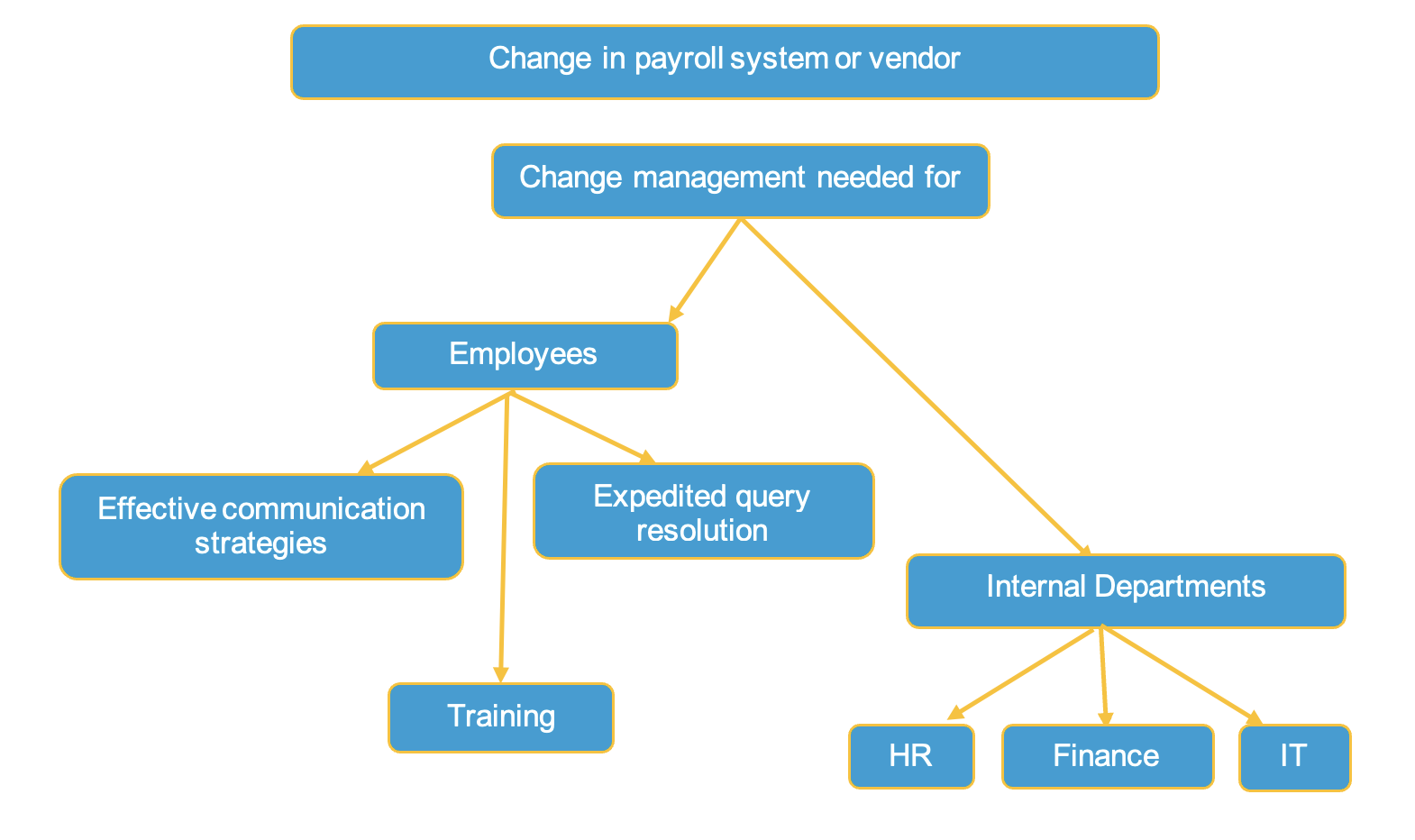
Employees solely depend on the payroll software for their payslips and relevant documents and to raise queries. When there is a change in the payroll solution, employees could find it difficult to navigate without effective communication and proper guidance. This calls for a proper plan to communicate the change:
When there is a change in the payroll system, there is a change in methods of accessing the current and old payslips and documents. For example, employees, who earlier received physical payslips, may henceforth get payslips in emails and those getting payslips in emails may have to access URLs to download their payslips. Even better, the new payroll software may have AI chatbots where they can directly ask for their payslips. A capability that becomes especially meaningful in global payroll software, where employees across time zones can get instant, localized responses without waiting on a regional payroll team.
In such scenarios, the employees must be communicated about the change and the plans made by the change management to introduce them to the new system. This should include ways to access the current documents as well as the old documents such as a-year-old payslips or joining letters. While emails are an effective mode of communication, they need not be the sole one.
There are several other ways to communicate the change to the employees. For example, featuring important messages on screens across floors of the organization. This way, every time employees walk through the corridors/reception area, they become aware of the changes. Another method could be gamification. It can help enhance employee engagement and motivation by incorporating game elements like points, badges, and rewards into the transition process. For example, introducing interactive challenges to encourage employees to learn and adapt to the new system. Real-time feedback and progress tracking can help identify areas needing support, while gamified tasks promote the adoption of new behaviors, such as using self-service portals. These processes can help in making communication smoother and more effective during the transition, driving higher adoption rates.
Training is crucial during payroll system or vendor change. Not only the simple processes to access payroll-related data like payslips, bonuses, leaves, etc., may change but also methods to raise queries. A payroll software change may also affect service level agreements (SLAs). Brandon Hall Group states, "Organizations that offer employees ample training opportunities see 3.5x greater change adoption rates than those with poor training."
For organizations transitioning to a multi-country payroll solution, this is also an opportunity to standardize training across markets, ensuring employees everywhere develop the same baseline familiarity with the system, regardless of the country they're in. This calls for proper training sessions by the change management committee to educate employees about the new processes and the change in service level agreements (SLAs).
To navigate the new application, the change management must provide employees with a simple user guide. A webinar training on the new platform is another way to educate employees. It must also conduct clear and concise targeted training to make employees understand the new procedure. Open training sessions for employees to ask their questions can also be beneficial. This will not only lead to faster implantation of the new payroll system but also a smooth employee experience.
To streamline the transition, a dedicated query resolution committee may be formed to expedite and enhance response accuracy during the system implementation phase. This will help accelerate response times and improve accuracy, minimizing employee frustration and improving employee experience. Establishing new user-friendly query channels and refining procedures within the new payroll system is another way to foster employee confidence during the payroll system transition phase. It will empower employees to seek assistance independently, fostering self-sufficiency and satisfaction. These initiatives collectively help enhance overall employee satisfaction and operational efficiency.
By ensuring employees feel informed, supported, and empowered throughout the process, organizations with the help of change management can help them reap the maximum benefits of the transition and the new payroll software. Thus, change management can become successful only when it prioritizes employee experience, maintains proactive communication and training, and builds strong collaboration with HR, Finance, and IT departments.
Stay tuned to find out change management’s role and responsibilities toward internal departments, including HR, finance, and IT.
Change management helps organizations minimize disruption during a payroll system transition by ensuring employees understand new processes, receive timely updates, and have access to the right support. A structured change management strategy improves adoption rates, reduces confusion, and creates a smoother payroll experience for employees and administrators.
A payroll system change can affect how employees access payslips, submit payroll queries, view tax documents, request leave, and interact with self-service portals. Without clear communication and training, these changes can lead to confusion, reduced productivity, and lower employee satisfaction.
Organizations should use multiple communication channels, including emails, employee portals, webinars, digital displays, FAQs, and interactive campaigns, to keep employees informed throughout the transition. Consistent and proactive communication helps build confidence and encourages faster adoption of new payroll processes.
Employee training helps users understand new payroll processes, self-service features, document access methods, and query resolution procedures. Well-designed training programs reduce support requests, improve user confidence, and enable employees to adapt to the new payroll system more quickly.
Creating dedicated support teams, implementing clear escalation processes, and providing multiple query channels can significantly improve payroll query resolution. Faster and more accurate responses reduce employee frustration, strengthen trust, and ensure a smoother payroll transition experience.
Effective change management keeps employees informed, supported, and engaged throughout the payroll transition process. Transparent communication, timely training, and accessible support resources help reduce uncertainty and create a more positive employee experience during organizational change.
Common challenges include employee resistance, communication gaps, inadequate training, delayed query resolution, and uncertainty around accessing payroll documents. A structured change management plan helps organizations address these challenges proactively and minimize disruption.
A successful payroll transition combines proactive communication, comprehensive employee training, dedicated support channels, stakeholder collaboration, and continuous feedback. Focusing on employee adoption and engagement helps organizations maximize the benefits of the new payroll system while ensuring business continuity.